
A student walks into our clinic at Athena Behavioral Health, sits down, and says the same thing we hear every single week: "I can't sleep before results come out." Or: "I check my phone the second I wake up, and I already feel behind." Or, quieter, after a long pause: "I don't know why I feel this way. I just do."
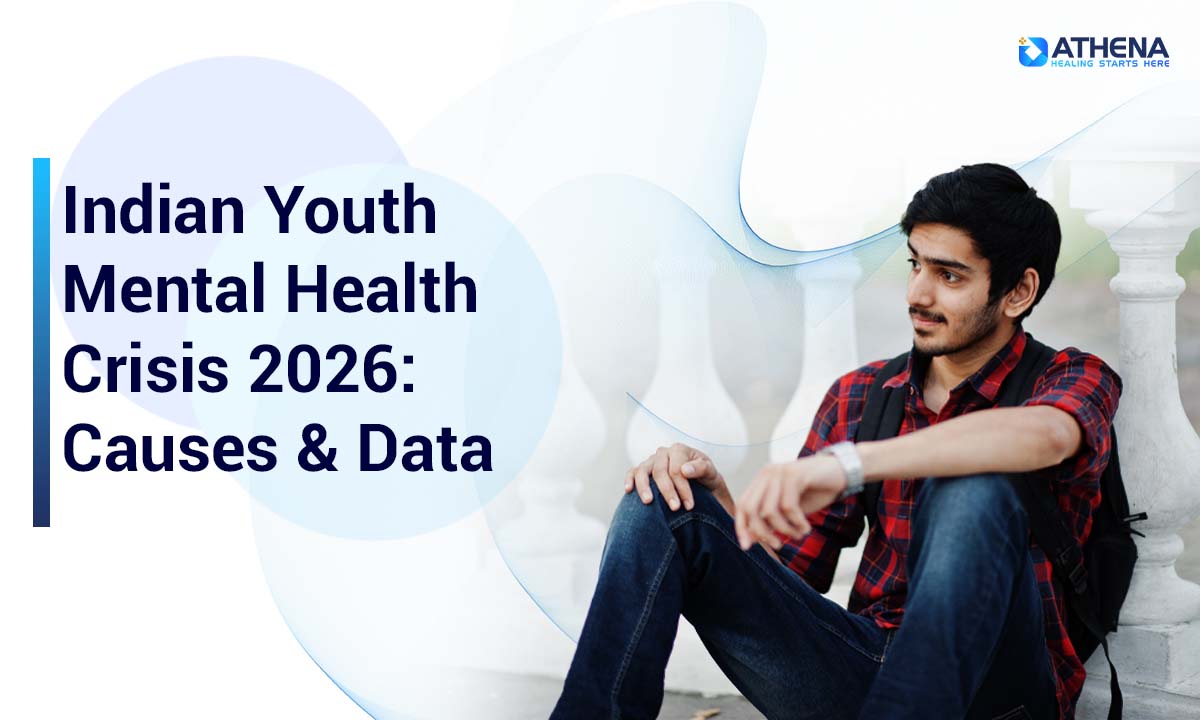
We don't need a report to tell us something has shifted in how young Indians are coping. We see it in our intake forms, hear it in parent phone calls, and track it in the questions students bring back, session after session. The Indian youth mental health crisis 2026 isn't a handful of anecdotes, it's a measurable, documented pattern, and government, WHO, and NMHS data all confirm it. Here's what the numbers say, what's driving them, what the government is doing about it, and what actually helps.
The National Picture: How Big Is the Indian Youth Mental Health Crisis 2026?
Start with the national numbers, and the scale is hard to ignore. According to the World Health Organization (WHO), more than 197 to 200 million Indians, roughly 1 in every 7 people, live with a diagnosable mental health condition. Some estimates from the Global Burden of Disease study put the figure at 197 million, with depression and anxiety alone affecting more than 90 million people. Over 83 percent of those affected receive no treatment at all. India carries 15 percent of the world's mental health burden, according to a 2017 Lancet study, with 56 million people affected by depression (4.5 percent of the population) and 38 million by anxiety disorders (3.5 percent).
Indicator | Figure | Source |
Indians living with a mental health condition | 197 to 200+ million (1 in 7) | WHO / Global Burden of Disease |
Share of global mental health burden carried by India | 15% | The Lancet, 2017 |
People affected by depression | 56 million (4.5%) | WHO |
People affected by anxiety disorders | 38 million (3.5%) | WHO |
National treatment gap (common disorders) | 83% to 85% | WHO / NMHS |
Treatment gap for severe mental disorders | 76% | NMHS |
Practising psychiatrists in India | Around 9,000 | Parliamentary Standing Committee, 2023 |
Psychiatrists needed to meet WHO minimum (3 per lakh) | At least 36,000 | Parliamentary Standing Committee, 2023 |
Psychiatrists per lakh population | 0.3 (WHO minimum is 1 to 3) | WHO / NMHS |
Clinical psychologists in India | 4,309 | Rehabilitation Council of India |
Rehabilitation social workers in India | 801 | Rehabilitation Council of India |
Share of national health budget on mental health | Around 1% to 2% | Government of India / Union Budget |
Lifetime prevalence of any mental morbidity | 13.7% | NMHS 2016 |
Current prevalence of mental morbidity among adults | 10.6% | NMHS 2016 |
The National Mental Health Survey (NMHS), India's most authoritative government backed study, found a lifetime prevalence of any mental morbidity at 13.7 percent, and a current prevalence of 10.6 percent among adults. Nearly 1 in 20 Indians lives with depression, and the rate climbs higher among women aged 40 to 49. Most states spend less than 1 percent of their health budget on mental health, and many have fewer than one psychiatrist per lakh population, a gap that hits young people hardest since they're the ones least likely to know where to look for help.
Indian Youth Are Falling Behind the Rest of the World, and Their Own Elders
Here's a data point that stopped us in our tracks. The Global Mind Health 2025 report from Sapien Labs surveyed 78,093 internet enabled Indians and ranked young adults aged 18 to 34 at 60th out of 84 nations on the Mind Health Quotient (MHQ), a score built to measure emotional, cognitive, and social functioning.
Age Group | MHQ Score | Global Rank (out of 84) | Category |
18 to 34 years | 33 | 60th | Distressed or Struggling |
55 years and above | 96 | 49th | Managing or Succeeding |
The global average sits at 66. So Indian youth aren't just trailing the rest of the world, they're trailing their own grandparents' generation by more than 60 points. Researchers point to a few lifestyle factors behind this gap:
- Only 64% of Indian youth feel close to their families, compared to 78% of those aged 55 and above
- Young adults with weak family ties are 4 times more likely to experience mental distress
- 44% of 18 to 34 year olds eat ultra processed food regularly, versus just 11% of the 55+ group
- The average age of first smartphone use has dropped to 16.5 years
- India's family closeness score still ranks 28th globally, showing the bond itself isn't broken, the pressure around it is
Indian Youth Mental Health Crisis 2026 in Numbers: The Student Reality
If the national figures are troubling, the student specific data is where the crisis shows its sharpest edge. The Indian Psychiatric Society reports that nearly 60 percent of all mental health cases now involve people aged 35 and under. UNICEF and ICMR data narrow this further into the student population.
Population Segment | Data Point | Source |
Indian college students with moderate to severe depression | 32% | ICMR, 2023 |
Indians aged 13 to 17 with a mental health condition | 14% | UNICEF, 2021 |
IIT-JEE / NEET aspirants reporting severe anxiety or depression | 1 in 5 (20%) | Institutional data |
Children aged 13 to 17 needing mental health support | 9.8 million | NMHS |
Youth (18-24) with anxiety or depression, early pandemic | 9.3% | WHO, 2020 |
Same age group, by March 2022 | 16.8% | WHO |
India's share of the world's adolescent population | 1 in 5 adolescents globally | Rashtriya Kishor Swasthya Karyakram (RKSK), MoHFW |
Adolescents (10 to 19 years) targeted under RKSK | 253 million | Ministry of Health and Family Welfare |
This drastic rise from 9.3 percent to 16.8 percent within less than two years clearly indicates the rapid deterioration of situations in terms of academics, loneliness, and social media. Given that nearly 65 percent of the population in India is below 35 years of age, even the slight change in percentages makes millions of youth fall in the bracket we see at Athena Behavioral Health.
A Decade High in Student Suicides: NCRB Data
The National Crime Records Bureau (NCRB) provides the starkest confirmation. Student suicides in India rose from 8,423 in 2013 to 13,892 in 2023, a 65 percent increase over a decade, making up 8.1 percent of all suicide deaths that year, up from 6.2 percent in 2013.
Year | Student Suicides | % of Total Suicides |
2013 | 8,423 | 6.2% |
2014 | 8,032 | 6.1% |
2017 | 9,905 | 7.6% |
2019 | 10,335 | 7.4% |
2020 | 12,526 | 8.2% |
2021 | 13,089 | 8.0% |
2022 | 13,044 | 7.6% |
2023 | 13,892 | 8.1% |
2024 | Rising further | 8.5% |
The total number of suicides committed by students in 2024 was 8.5 percent of the 1,70,746 total suicide deaths that were recorded in the country as a whole, at a national level suicide rate of 12.2 per 100,000 persons. “Failure in examination” was the cause for over 1,300 student suicides under the age of 18.
What Is the Government Doing About the Indian Youth Mental Health Crisis 2026?
This is a question we get from worried parents constantly, and the honest answer is: more than most people realize, but not nearly enough yet.
Programme | What It Does | Key Stats |
Tele MANAS (National Tele Mental Health Programme) | 24x7 toll free helpline (14416 / 1800-891-4416) offering counselling in 20 languages, launched October 2022 | Over 29.8 lakh calls handled by November 2025; grew from 12,000 calls in December 2022 to over 90,000 calls per month by May 2024; nearly 70% of callers are aged 18 to 45; 53 Tele MANAS cells across 36 states and UTs |
District Mental Health Programme (DMHP) | Outpatient care, counselling, medicines, and 10-bed inpatient facilities at district hospitals | Active in 767 districts |
National Mental Health Programme (NMHP) | Umbrella programme since 1982 integrating mental healthcare into general healthcare | Chronically underfunded, under 2% of the health budget |
Rashtriya Kishor Swasthya Karyakram (RKSK) | Adolescent mental health through peer education and Adolescent Friendly Health Clinics | Targets 253 million adolescents aged 10 to 19 |
Manodarpan | Ministry of Education initiative for psychosocial support to students, teachers, and families, including exam aspirants | Nationwide, school to university level |
Mental Healthcare Act, 2017 | Legal framework recognizing the right to mental healthcare | Decriminalised suicide attempts nationally |
Ayushman Bharat / PM-JAY | Cashless treatment for 22 specified mental health procedures at upgraded health centres | Over 1.75 lakh Sub Health Centres and PHCs upgraded |
Despite this policy activity, funding tells a more sobering story. The Ministry of Health and Family Welfare's budgeted expenditure for FY 2025-26 stands at roughly ₹99,859 crore, yet Tele MANAS itself saw its budget cut from ₹134 crore in FY 2023-24 to ₹80 crore in FY 2025-26, even as call volumes kept climbing. Mental health overall still receives close to 1 percent of the total health budget in most states, well below what experts recommend.
So Why Is This Happening? It's Rarely Just One Thing
Our clients rarely single out a particular reason for the mental health crisis among Indian youth 2026. Instead, it is always two or three factors combined until they finally crack.
- Examinations have become identity, not just evaluation: Students give their board exams, NEET, JEE, CUET, CA, UPSC all years of their youth in exchange for a score, which then defines their identity completely. NMHS research suggests that the current mean age of onset for mental disorders is 19 to 20 years, which coincides with higher education age.
- Job market immediately continues what exams started: Layoffs, unpaid internships, and pressure to "choose the right specialization" keep young Indians worried about their future.
- Social media is no background noise; it is a factor in itself: The 2025 study showed that 65 percent of Indian adolescent girls suffered from genuine distress caused by social comparison on online platforms especially concerning appearance and lifestyle.
- Close relationship with family does not make the situation better – the pressure makes it worse: Coaching, tuition fees, increased living expenses, and the silent pressure in a close-knit family.
- Family closeness isn't the problem, the pressure wrapped around it is: Coaching fees, tuition loans, rising living costs, and unspoken expectations add strain even in close families.
- Help is hard to find: With just 0.3 psychiatrists per lakh population against a WHO minimum of 1 to 3, and specialists concentrated in metro cities, students in smaller towns often wait months for an appointment.
The Urban Rural and Gender Divide
A few relatable patterns show up again and again in national data and in our own clinical experience:
Factor | What the Data Shows |
Urban vs rural access | Most of India's roughly 9,000 psychiatrists are concentrated in metro cities, leaving large parts of rural India with close to zero specialist access |
Gender | Depression prevalence is higher among women aged 40 to 49 (NMHS), while adolescent girls report higher rates of social media related distress (65%, 2025 study) |
Age of onset | Average onset of mental illness is 19 to 20 years, coinciding with board exams, entrance tests, and the first years of college |
Digital exposure | Average age of first smartphone use has fallen to 16.5 years, correlating with lower MHQ scores in the 18 to 34 age group |
Anxiety in Indian Students: Warning Signs to Watch
Recognising these signs early makes a real difference in how fast recovery happens.
Category | Common Warning Signs |
Emotional | Constant worry, irritability, sudden mood swings, hopelessness |
Physical | Headaches, fatigue, appetite changes, disturbed sleep |
Behavioural | Withdrawal from friends, skipping classes, declining grades |
Cognitive | Trouble concentrating, racing thoughts, indecisiveness |
Digital | Compulsive scrolling, anxiety when away from phone, comparing self to others online |
If several of these signs appear together and last more than two weeks, it usually points toward something that needs professional attention rather than willpower alone.
Treatment We Offer at Athena Behavioral Health
Anxiety Disorder Treatment and Panic Disorder Treatment
Our anxiety disorder treatment is based on the combination of CBT along with breathing and grounding techniques for those who suffer from racing thoughts, constant fear, or even panic attacks before taking an exam. Our panic disorder treatment is focused on physical symptoms such as rapid heartbeat and shortness of breath in order to make a person break the circle of panic. In light of youth depression and anxiety cases increasing almost twice in less than two years because of the pandemic, early treatment makes a huge difference.
Depression Treatment
Our depression treatment for young people blends therapy with structured lifestyle changes around sleep, movement, and daily routine. With 32 percent of Indian college students showing moderate to severe depression per ICMR, early treatment prevents the condition from deepening into long-term academic or career disruption. In more severe cases, our psychiatrists also recommend medication alongside therapy.
Psychotherapy and Counselling
The core of the treatment for most of our clients is in this, a non-judgmental place where clients can work through issues relating to academic stress, career anxiety, and familial problems.
Mindfulness, Yoga, and Wellness
Regular practices such as guided breathing, meditation, and yoga reduce one’s base level of stress and help in improving sleep patterns, making psychotherapy that much more effective.
Corporate Mental Health and Employee Assistance Programs
This crisis is not over once a client graduates from high school or university. Career anxiety becomes occupational burnout once one begins their professional life. Our EAP provides confidential services for employees.
What Can Help: Practical Steps for Everyone Involved
For Students:
- Build a consistent sleep schedule instead of sacrificing rest for study hours
- Set fixed screen time limits to reduce social media stress
- Talk to a trusted adult or professional counsellor before stress becomes overwhelming
- Break large academic goals into smaller, weekly targets
For Parents and Families:
- Separate love and approval from exam results or job titles
- Normalise conversations about therapy and counselling at home
- Watch for early warning signs rather than waiting for a crisis
- Avoid comparing siblings or children to relatives and classmates
For Schools, Colleges, and Employers:
- Set up well staffed counselling support for every campus
- Train teachers to identify early signs of student stress, in line with the Ayushman Bharat School Health and Wellness Programme's approach
- Introduce a proper Corporate Mental Health and Employee Assistance Program for young hires
- Run regular mindfulness, yoga, and wellness sessions rather than one time events
Conclusion
The Indian youth mental health crisis 2026 manifests itself through Indian classrooms, hostels, entry-level jobs, and family dinner tables. The data from the WHO, NMHS, ICMR, NCRB, as well as the government budget all reveal the same alarming situation: 197 to 200 million Indians struggling with mental problems, an 83 to 85 percent treatment gap, just 9,000 available psychiatrists when 36,000 are needed, and student suicides hitting an all-time high of 13,892 cases in 2023. The combination of academic pressure, career anxiety, and media stress feeds into one another leading to anxiety disorders, burnout, and in the worst-case scenarios, suicide.
The good news is that the early detection and treatment of anxiety disorder and depression have been proven effective and government projects such as Tele MANAS, DMHP, RKSK, and Manodarpan are slowly extending it to more Indians, despite the lack of funding for the time being. At Athena Behavioral Health, we see it on a daily basis, and our programs are designed in order to provide help precisely to young Indians who face the problem. Changes will not come instantly, but every conversation and treatment really does make things easier for this generation.