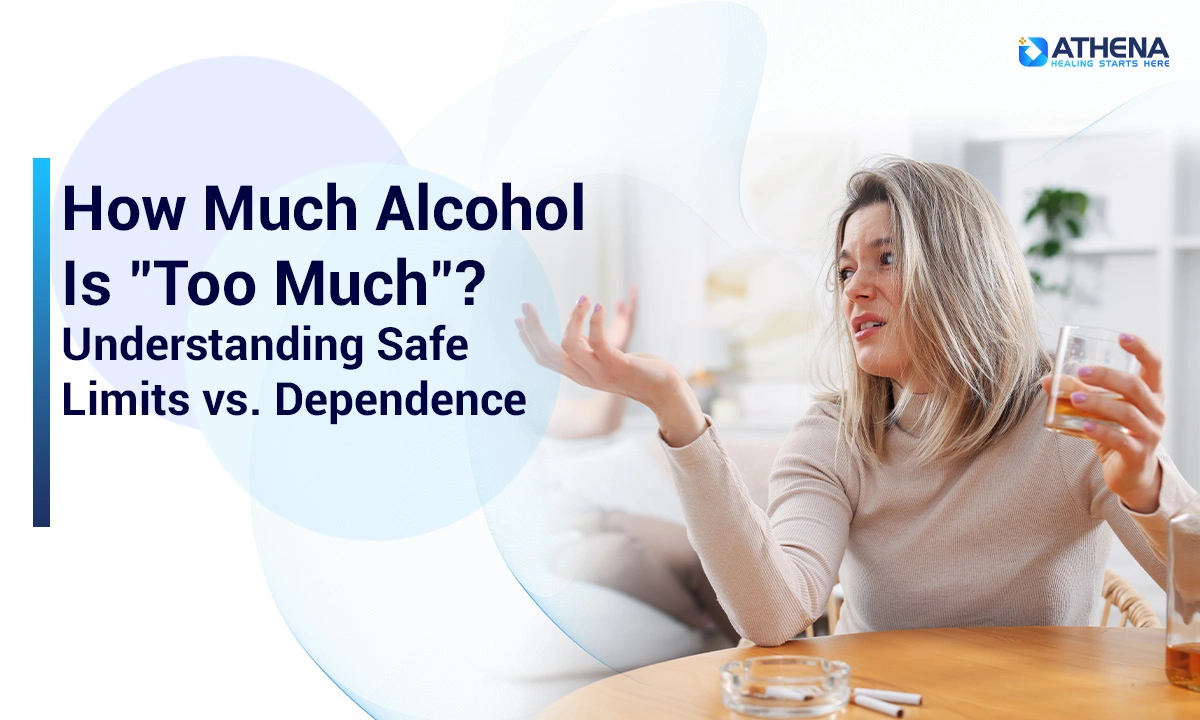

How much alcohol is too much depends on the amount, frequency, drinking pattern, and its effect on your health and daily life. There is no completely risk-free level of alcohol use. Binge drinking, repeated heavy drinking, loss of control, tolerance, cravings, or withdrawal can indicate a serious alcohol-related problem requiring professional assessment.
How much alcohol is too much? There is no single number that applies equally to everyone. Risk rises with the amount and frequency of drinking, while loss of control, cravings, tolerance, or withdrawal may point toward alcohol dependence. If drinking is becoming difficult to manage, Athena Behavioral Health can help you explore appropriate professional treatment. The important question is what happens next.
How Much Alcohol Is Too Much?
The answer starts with an important distinction: drinking above a recommended limit is not automatically the same as alcohol dependence, and drinking below a guideline does not guarantee zero health risk.
Alcohol-related harm exists on a spectrum. According to the National Institute on Alcohol Abuse and Alcoholism (NIAAA), even lower amounts of alcohol can carry some health risks, while those risks generally increase as alcohol consumption increases. Drinking patterns such as binge drinking and heavy alcohol use can also increase the likelihood of developing Alcohol Use Disorder (AUD).
Public-health recommendations vary between countries, so it is best to follow guidance applicable to where you live. More importantly, some people should avoid alcohol altogether, including people who are pregnant, people taking certain medications, and those with particular health conditions or a history of AUD.
The bigger concern is when alcohol stops being an occasional choice and begins affecting your ability to function, your relationships, your health, or your control over drinking.
What Is a Standard Drink?
Understanding a standard drink can make alcohol consumption easier to assess because the size of a glass does not necessarily tell you how much alcohol it contains.
In the United States, NIAAA defines one standard drink as approximately 14 grams of pure alcohol. This is roughly equivalent to:
12 ounces of regular beer at about 5% alcohol
5 ounces of wine at about 12% alcohol
1.5 ounces of distilled spirits at about 40% alcohol
However, real-world servings can be considerably larger, and alcohol percentages differ between products. For example, a large glass of wine or a strong craft beer may contain more than one standard drink.
This is why simply counting glasses can underestimate actual alcohol intake. Understanding
How Drinking Patterns Affect Alcohol-Related Risk
The amount you drink matters, but how you drink also matters.
Someone who drinks a large amount over a short period may face immediate risks even if they do not drink every day. Conversely, someone who drinks smaller amounts very frequently may gradually develop tolerance or rely on alcohol as part of their daily routine.
Occasional or Social Drinking
Occasional drinking does not automatically indicate a disorder. However, context matters. Drinking can become concerning when it repeatedly leads to unsafe decisions, interpersonal problems, impaired responsibilities, or other consequences.
Binge Drinking
NIAAA defines binge drinking as a pattern that typically brings blood alcohol concentration to 0.08% or higher. For a typical adult, this corresponds to about four or more drinks for women or five or more for men within approximately two hours.
Binge drinking increases the risk of injuries, alcohol poisoning, impaired judgment and other immediate harms.
Regular or Heavy Drinking
Regular drinking becomes more concerning when quantities increase, drinking becomes difficult to skip, or alcohol is repeatedly used to cope with stress, sleep problems, anxiety or difficult emotions.
Alcohol Dependence
Dependence involves more than simply drinking a large quantity. It can involve impaired control, strong cravings, tolerance, withdrawal symptoms, and continued drinking despite harmful consequences.
Athena Behavioral Health describes alcohol addiction as Alcohol Use Disorder, a condition associated with compulsive alcohol use, loss of control, and continued consumption despite physical, psychological, or social consequences.
Is Drinking Within Recommended Limits Always Safe?
No. A drinking guideline should not be interpreted as a guarantee that a particular amount of alcohol is harmless.
Health risks can vary according to factors such as age, biological sex, medications, medical conditions, pregnancy, family history, and previous alcohol-related problems. Alcohol can also interact with certain medicines and worsen some physical or mental health conditions.
NIAAA notes that alcohol-related harms can occur at any level of consumption, with risk generally increasing as intake increases.
For that reason, “within the limit” and “risk-free” should never be treated as interchangeable terms.
If you already have difficulty controlling your drinking, simply trying to stay below a numerical threshold may not address the underlying problem.
What Are the Signs That Alcohol Is Becoming a Problem?
One of the clearest ways to assess problematic drinking is to look beyond the number of drinks.
Consider whether you:
Drink more or for longer than you intended.
Have tried to cut down but struggled to do so.
Experience strong cravings for alcohol.
Need more alcohol than before to feel the same effect.
Continue drinking despite problems at home, work or in relationships.
Give up activities because drinking has become a priority.
Drink in situations where it increases your risk of injury.
Experience symptoms when alcohol wears off.
Continue drinking even when it worsens your physical or mental health. Review key
alcohol not under control warning signs
These are among the symptoms clinicians consider when assessing AUD. NIAAA notes that healthcare professionals diagnose AUD based on a pattern of symptoms rather than simply the number of drinks consumed.
Athena similarly highlights cravings, loss of control, tolerance, withdrawal and continued alcohol use despite consequences as important warning signs. Learn more about
How Much Alcohol Is Too Much If You Drink Every Day?
Daily drinking does not automatically mean someone has alcohol dependence, but it is worth examining the pattern closely.
Ask yourself:
Can I comfortably choose not to drink?
If alcohol has become something you feel you need every evening to relax, sleep, manage stress or feel normal, that pattern deserves attention.
Tolerance can also be an important warning sign. If one drink no longer produces the effect it once did and you gradually need more, your relationship with alcohol may be changing.
The purpose of asking how much alcohol is too much is therefore not simply to calculate a number. It is to understand whether alcohol is becoming increasingly important in your life and increasingly difficult to control.
How Do You Know If Drinking Has Become Alcohol Dependence?
Alcohol dependence is a clinical concern and cannot be diagnosed from drinking quantity alone.
A healthcare professional may look at whether you experience:
impaired control over drinking
repeated unsuccessful attempts to reduce alcohol use
cravings
increasing tolerance
withdrawal symptoms
continued drinking despite physical or psychological problems
disruption to work, family or social responsibilities
NIAAA explains that AUD can range from mild to severe depending on the number of diagnostic symptoms present.
This distinction matters. Someone may drink heavily without meeting criteria for dependence, while another person may have significant alcohol-related problems at a lower level of consumption.
What Happens When Someone With Alcohol Dependence Stops Drinking?
Stopping alcohol can be beneficial, but abruptly stopping after prolonged heavy drinking can be medically dangerous for someone who is dependent.
Withdrawal may involve:
tremors
sweating
anxiety
nausea or vomiting
insomnia
increased heart rate
seizures
hallucinations
delirium tremens
NIAAA warns that alcohol withdrawal can become life-threatening and that some people require medical monitoring or detoxification.
This is why someone with suspected dependence should not assume that suddenly stopping at home is automatically the safest option.
Seek urgent medical attention for severe symptoms such as seizures, severe confusion, hallucinations, inability to stay conscious, or significant breathing problems.
Can Drinking Too Much Affect Physical and Mental Health?
Yes. Alcohol can affect multiple areas of health, particularly when consumption is frequent or excessive.
Liver Health
Long-term heavy alcohol use can contribute to liver disease and other serious complications.
Brain and Nervous System
Alcohol affects brain function, coordination, judgment, and memory. Chronic heavy use can also contribute to neurological problems.
Mental Health
Alcohol use and mental health conditions can influence each other. Anxiety, depression and trauma can coexist with AUD, making assessment and treatment more complex. Athena identifies depression, anxiety, PTSD and other mental health conditions among issues that may co-occur with alcohol addiction.
Relationships and Daily Life
Alcohol-related problems can affect family relationships, employment, finances and social functioning.
The important point is that alcohol-related harm is not limited to physical disease. A person's relationships, responsibilities and quality of life can also reveal that drinking has become problematic.
What If You Are Drinking More Than You Intended?
Start by paying attention to the pattern rather than judging yourself.
Notice when you drink, how much you consume, what triggers drinking, and what happens afterward. If you repeatedly plan to have one or two drinks but end up drinking substantially more, that loss of control is worth discussing with a healthcare professional.
You also do not need to wait for a crisis before seeking support.
A professional assessment can help determine whether your drinking reflects risky use, problematic drinking, or AUD, and what level of care may be appropriate.
Why Does Alcohol Dependence Develop?
There is rarely one single cause.
Risk can be influenced by:
genetic and biological factors
stress and trauma
mental health conditions
social environment
repeated heavy alcohol exposure
family history
learned coping patterns
Athena notes genetic predisposition, psychological factors, environmental influences and co-occurring mental health conditions among factors associated with alcohol addiction.
Understanding these influences is important because alcohol dependence is not simply a matter of poor character or insufficient willpower. It is a health condition that can require structured treatment.
When Should You Seek Professional Help?
Consider speaking with a healthcare professional if you cannot reliably control your drinking, repeatedly try to cut down without success, experience cravings or withdrawal, or continue drinking despite harm.
Professional help becomes particularly important if alcohol is affecting your work, family, relationships, physical health or emotional wellbeing.
Treatment does not necessarily look the same for everyone. Depending on clinical needs, care may involve outpatient treatment, residential care, medically supervised withdrawal, therapy, medication, or continuing recovery support.
How Is Alcohol Addiction Treated?
Effective treatment addresses more than the immediate act of stopping alcohol.
Medical Detoxification
For people at risk of withdrawal complications, medically supervised detox can provide monitoring and appropriate treatment during withdrawal.
Psychiatric Assessment
Assessment can identify AUD severity and co-occurring conditions that may influence recovery.
Behavioural Therapy
Evidence-based approaches such as Cognitive Behavioural Therapy and Motivational Interviewing can help people understand triggers, change behaviours and develop healthier coping strategies.
Medication Support
Certain medications may be used when clinically appropriate to reduce cravings or support recovery. Treatment decisions should be made by a qualified healthcare professional.
Relapse Prevention and Aftercare
Recovery often requires ongoing support after the initial treatment phase. Aftercare can help people recognise triggers, strengthen coping skills and maintain progress.
Athena Behavioral Health's alcohol treatment programme includes medically supervised detoxification, psychiatric evaluation, CBT and Motivational Interviewing, clinically indicated medication support, relapse prevention and aftercare. Its programmes are described as personalised and confidential.
Alcohol Addiction Treatment at Athena Behavioral Health
If you have reached a point where asking how much alcohol is too much feels less like curiosity and more like a concern about your own drinking, it may be time to look beyond limits and consider support.
Athena Behavioral Health's alcohol addiction treatment provides a structured clinical approach for people experiencing alcohol-related problems. The programme includes assessment, medically supervised detox when required, psychotherapy, clinically appropriate medication support, relapse prevention and aftercare.
Athena also offers different care settings and treatment centres, allowing the clinical team to assess which approach is most appropriate for an individual's needs.
Take the First Step Toward Recovery
You do not have to wait until drinking has caused a major crisis before asking for help.
If alcohol is becoming difficult to control, speak with the clinical team at Athena Behavioral Health for a confidential assessment and guidance about appropriate treatment options.
Your drinking pattern does not have to define your future. Reach out to Athena Behavioral Health and take the first step toward getting the support you need.
Medical Disclaimer: This article is for general educational purposes and does not diagnose alcohol dependence or replace individual medical advice. If you may be physically dependent on alcohol, consult a qualified healthcare professional before stopping suddenly. Severe withdrawal symptoms require urgent medical attention.