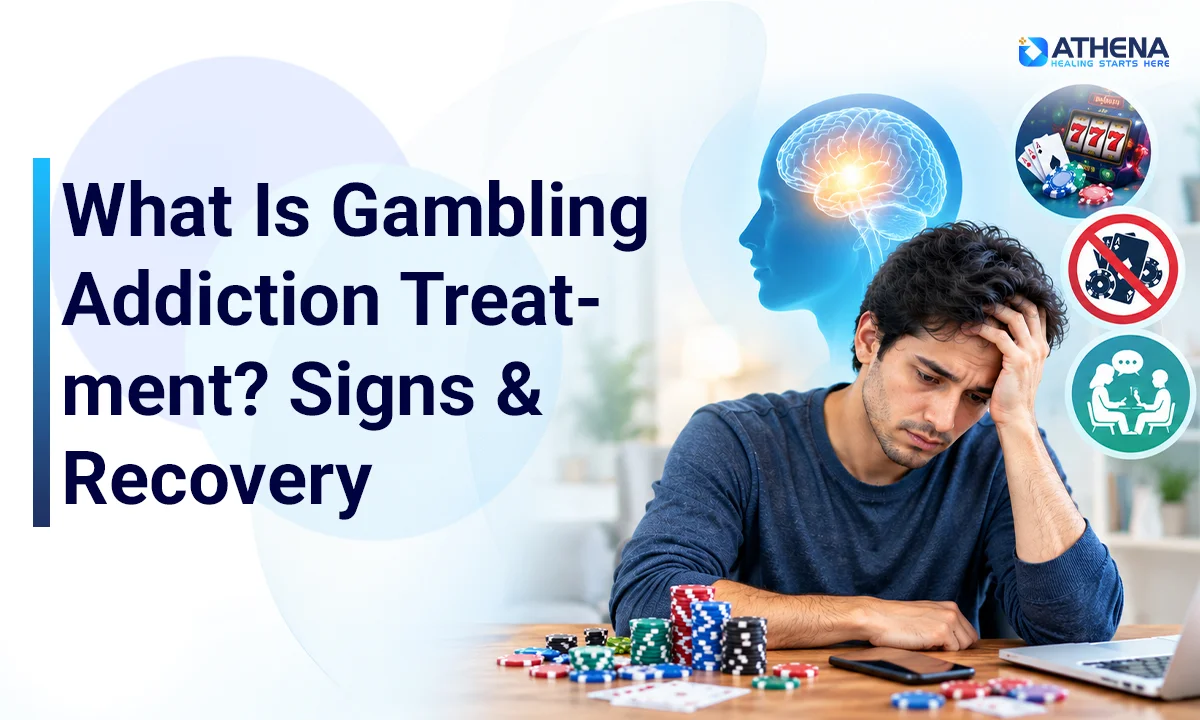

What is gambling addiction treatment, and does it actually work for someone who can't stop betting? It does. Gambling addiction treatment is professional care that helps a person stop compulsive gambling, understand what keeps driving it, and repair the money, family and health problems it left behind. Below you will find the warning signs, causes, treatment options and a realistic picture of recovery in India.
What Is Gambling Addiction Treatment and How Does It Work?
The treatment will be performed by mental health experts and involve more than just "quit." This will cover the gambling itself, the thoughts that justify it, the emotions that trigger it, and the harm it does. The treatment program will contain:
A proper evaluation: a psychiatrist or a psychologist evaluates your gambling background, mood, and substance abuse.
Treatment for gambling addiction: cognitive behavioral therapy (CBT) is the most extensively researched method. The therapy trains how to challenge thoughts such as "it's my turn to win," control the urges, and prepare for risky situations. Normally, gambling goes down dramatically within the first three months of CBT.
Other therapies: motivational interviewing, family therapy, and self-help group therapy like Gamblers Anonymous.
Medication if required: there is no medication approved for gambling disorder, although the treatment of depression, anxiety, or alcohol dependency will make recovery more stable.
Financial counseling: a strategy to settle debts, ideally involving a family member.
What Is Gambling Addiction?
Gambling addiction, called gambling disorder in medicine, means you keep gambling even when it is clearly hurting your life. It has little to do with willpower. Betting triggers the brain's reward system in a way similar to alcohol and drugs, which is why doctors place it among the addictive disorders. A diagnosis is made when four or more of nine symptoms show up within 12 months.
Signs of Gambling Addiction
The signs of gambling addiction are easier to catch early if you know the pattern. Watch for these:
Raising bets to feel the same excitement
Getting restless or snappy when you try to cut down
Promising to stop, then going back again and again
Thinking about gambling for most of the day
Betting to escape stress, sadness or guilt
Chasing losses by betting again to win the money back
Lying about how much time or money goes into it
Putting your job, studies or relationship at risk
Borrowing money from others to cover losses
How many apply tells you how serious it is: 4 to 5 is mild, 6 to 7 is moderate, 8 to 9 is severe. If four or more fit, talk to a mental health professional.
Gambling Addiction Symptoms: Emotional, Financial and Physical
Symptoms spread across different parts of life, and some are hard to see from outside.
Areas | What you may notice |
Emotional | Shame, guilt, anxiety, low mood, short temper |
Financial | Regular borrowing, full credit cards, missed payments |
Social | Secrecy, avoiding family, fights over money |
Physical | Broken sleep, headaches, constant tension |
Family usually notices before the person admits anything.
What Causes Gambling Addiction?
There is no single reason. The causes of gambling addiction come from a mix of brain chemistry, life situation and easy access. Stress that never gets addressed also pushes many people toward habits that feel like relief but make things worse.
Common causes include:
A big early win that makes winning feel easy.
The brain's reward loop, where not knowing the outcome is the thrill.
Pressure, loneliness or debt, with betting used to escape.
Other health conditions: among people seeking help for gambling harm, about 56% also have nicotine dependence, 23% a mood disorder, 21% an alcohol use disorder and 18% an anxiety disorder.
Round-the-clock access through phones and websites.
How Common Is Gambling Addiction in India?
Research from India shows it is more widespread than most families think, especially among the young.
Groups | Finding |
Men in a Goa community survey | 45.4% gambled in the past year |
Kerala college students | 7.4% had problem gambling |
Kerala students who had gambled | About 38% had a gambling problem |
Kerala high school students (15 to 19) | 27.9% had gambled; 7.1% were problem gamblers |
Best Treatment for Gambling Addiction: Which Level of Care Fits?
The best treatment for gambling addiction depends on how severe the problem is, how safe the person is and how much support they have at home.
Levels of care | Best for | What it involves |
Outpatient (OPD) | Mild to moderate, supportive home | Regular therapy while staying at home |
Day care | Moderate, needs more structure | Therapy for several hours, home at night |
Inpatient | Severe, repeated relapse, risk of self-harm | Supervised care around the clock, away from triggers |
When gambling comes with depression, heavy drinking or thoughts of self-harm, a stay in inpatient psychiatric care gives the person a safe place to stabilise first. If someone has tried and failed to quit several times, stepping up a level is a reasonable move.
Gambling Addiction Treatment in India After the 2025 Online Gaming Ban
Real-money online gaming was outlawed under India’s Online Gaming Regulation Act of 2025; however, the issue persisted. Offshore betting sites remain accessible via VPNs, while local bookmakers, whose services cater to most of the cricket bets, remained unaffected by the act. Once one option goes, the urge seeks an alternative path. That is the reason why treatment and relapse prevention plan are still essential.
Women have additional social stigma to deal with. Women tend to make bets secretly using casinos or rummy application apps to escape their domestic troubles, and the fear of judgment holds them back from seeking assistance.
How to Stay Gambling-Free After Treatment
Recovery has good weeks and bad ones. A slip tells you what to adjust; it doesn't erase your progress. These habits help:
Delete betting apps and let someone you trust handle your cards and accounts.
Write down your risky times, such as match days, payday and late nights, and decide what you'll do instead.
Keep going to therapy after the main programme ends.
Calm cravings and restlessness with mindfulness and yoga, which many people find steadying.
Face your debt openly instead of hiding it.
Stay close to people who back your recovery.
After three months with no symptoms, doctors call it early remission. After twelve months, it is sustained remission.
Gambling Addiction Treatment at Athena Behavioral Health
Betting problems rarely look the same from one person to the next. One person is stuck on IPL match days, another on late-night rummy or casino apps, and a third is hiding loans from family. At Athena Behavioral Health, we offer gambling addiction treatment built around these real patterns, in a confidential and judgment-free setting.
Here is how our gambling care works:
Assessment first: Our psychiatrists and psychologists will assess your betting, level of debt, your mood and safety before creating your treatment plan.
Compulsion therapy: The sessions are about triggers, chasing losses thoughts and actions to take when the compulsion comes.
Family therapy: Working with family on understanding the event and restoring trust, discussing privacy issues with you first.
Inpatient care when necessary: In case of severe cases and safety concerns, with immediate admissions available.
Relapse prevention plan: It will include an aftercare plan with additional support during cricket season.
Where we work: Gurgaon (with a women only facility), Delhi, Greater Noida and Guwahati.