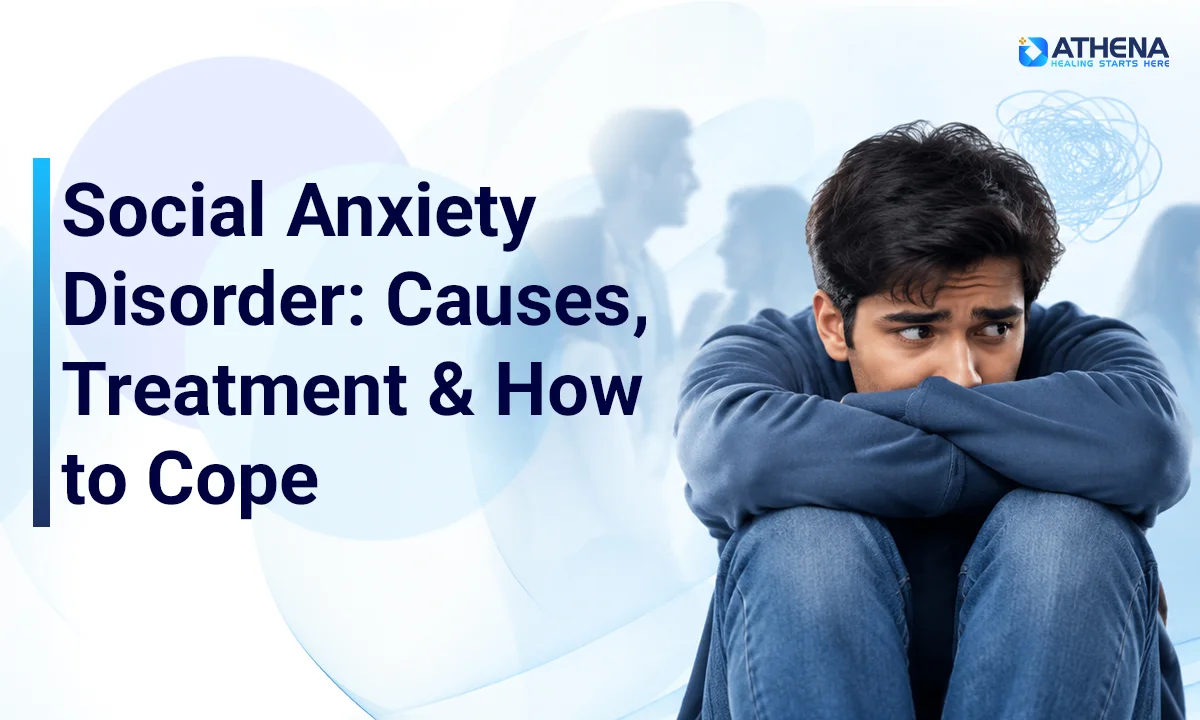

You are scheduled for a meeting in ten minutes, but your palms are already sweating. You have rewritten the same message twice and yet you still haven't managed to hit 'send'. Your friend asks you to join her for dinner and you accept. You then spend the week praying for an emergency to fall upon you.
If this sounds familiar, you are not being dramatic, and you are not the only one. Social anxiety disorder is one of the most common anxiety conditions, yet most people who live with it never talk about it. This guide explains what it is, how it shows up, why it develops, which treatments work and what you can start doing today. It is written in plain language, whether you are reading for yourself or for someone you care about.
What Is Social Anxiety Disorder?
Social anxiety disorder is a chronic problem wherein regular encounters trigger intense fear of being evaluated, embarrassed or rejected. The fear is more than just feeling nervous. This affects how one chooses careers, how one participates in class and even how one answers calls on the telephone.
The individuals suffering from this condition have a clear view that the fear is excessive compared to the reality of the situation. Realization does not help to turn the fear off. The brain predicts the danger while the body feels threatened.
How Common Is Social Anxiety? Key Facts and Figures
Numbers show how widespread this condition is and how often it goes unaddressed.
About 7.1% of adults have social anxiety disorder in any given year.
About 12.1% of adults will have it at some point in their lives.
The usual age of onset is around 13 years.
Many people live with symptoms for years before they ask for help.
In short, it is common, it starts early, and it is often left alone for far too long. The National Institute of Mental Health offers a short overview if you want a second source.
Is Social Anxiety a Mental Disorder?
Yes, Social anxiety disorder is a recognised mental health condition listed in the DSM-5, the diagnostic manual used by psychiatrists and psychologists. It belongs to the group of anxiety disorders.
The word "disorder" doesn't mean your character is faulty. It means the brain's alarm system reacts too strongly to social situations, a pattern that is well studied and responds to treatment. It is not a lack of willpower, and it is not weakness.
Social Anxiety vs Shyness vs Introversion
These three might be often confused, but they are different experiences. “Shyness is an experience of awkwardness.” “Introversion means having a preference for being in a calm environment.” Social anxiety means an experience based on fear.
Features | Shyness | Introversion | Social Anxiety Disorder |
What it is | Temporary awkwardness | Personality trait | Mental health condition |
What drives it | Unfamiliar situations | Need for quiet to recharge | Fear of judgment |
Eases with comfort? | Usually | Not applicable | Often not |
Avoidance | Rare | By choice | Frequent and distressing |
Physical symptoms | Mild | None | Racing heart, sweating, trembling |
Affects daily life? | Seldom | No | Yes |
Treatment needed? | No | No | Often helpful |
A simple way to tell them apart: an introvert thinks, "I'd rather stay in tonight." A person with social anxiety thinks, "I want to go, but I'm scared of how I'll come across." You can be both at once.
Social Anxiety Symptoms: Emotional, Physical and Behavioural Signs
The signs of social anxiety fall into three groups: what you feel, what your body does and how you act.
Emotional symptoms
Constant worry about saying or doing something embarrassing
Dread that starts days or weeks before an event
Replaying conversations afterwards and picking them apart
Fear that others can see how nervous you are
A harsh inner voice that gets louder around people
Physical symptoms
Pounding heart or tight chest
Blushing, sweating or shaky hands
Dry mouth, trembling voice or a blank mind
Nausea, stomach knots or dizziness
Tense shoulders and a clenched jaw
Behavioral symptoms
Skipping gatherings, classes or meetings
Avoiding eye contact or speaking as little as possible
Needing a friend beside you in social situations
Turning down promotions, presentations or new opportunities
Using alcohol to feel relaxed around others
Social Phobia Symptoms in Daily Life
Symptom lists can appear impersonal. Symptoms of social phobia manifest themselves in daily life experiences.
Skipping eating lunch with others because the cafeteria is overwhelming.
Checking a letter ten times before sending it out.
Staying silent during discussions despite having the answer.
Letting the phone go straight to voicemail and being scared to make return calls.
Leaving the party early since your body does not feel like yours anymore.
Feeling worn-out from being in the presence of others since you have been watching yourself all the time.
If some of the listed activities are recognizable to you, it is better to seek advice from an expert rather than blaming your personality.
Common Triggers of Social Anxiety
Triggers differ from person to person, but a few come up again and again.
Speaking in public or in team meetings.
Introducing yourself or making small talk.
Eating or drinking in front of others.
Phone calls and video calls.
Job interviews and performance reviews.
Being the centre of attention, even briefly.
Being watched while working, writing or performing.
Using shared or public restrooms.
Writing down which ones affect you, and how strongly, gives you and your therapist a clear starting point.
Social Anxiety in Children and Teenagers
Since most cases begin in early adolescence, parents and teachers are often the first to notice. In young people it doesn't always look like worry. It can look like rudeness, laziness or stubbornness.
Freezing, crying or going silent when asked to speak.
Refusing to go to school or join class activities.
Headaches or stomach aches before social events.
Clinging to a parent in unfamiliar places.
Falling grades because of fear of answering questions or presenting.
A child who seems very shy needs understanding, not pressure. Early support makes it much less likely that the pattern continues into adult life.
What Causes Social Anxiety? Risk Factors Explained
There is rarely a single answer to what causes social anxiety. Several influences usually combine over time, and the mix differs for each person.
1. Family history: Anxiety tends to run in families. A close relative with an anxiety disorder raises your chances, partly through inherited traits and partly through what you saw at home.
2. How the brain handles threat: The amygdala, the brain's alarm centre, may react too strongly to faces, criticism or attention. Chemical messengers such as serotonin also affect how calm or worried you feel.
3. Painful early experiences: Bullying, mockery, exclusion or public humiliation can teach the mind that people are unsafe. Very critical or overprotective parenting can add to this.
4. Temperament: Children who are naturally cautious or easily overwhelmed by new situations are more likely to develop social anxiety later.
5. Big life changes: A new school, a new job, a move to another city or a sudden public-speaking task can bring symptoms to the surface in someone already vulnerable.
6. Online comparison: Hours of scrolling through polished lives can sharpen the fear of being judged, especially for teenagers and young adults.
Conditions That Often Occur With Social Anxiety
Social anxiety seldom travels alone. It often overlaps with other difficulties, and untreated, they can feed each other.
Depression, especially after long periods of isolation.
Generalised anxiety and panic attacks.
Low self-esteem and constant self-doubt.
Sleep problems and ongoing physical tension.
Drinking to cope with social situations.
Because of this overlap, a proper assessment matters. How clinicians evaluate and plan care for anxiety in general is explained well in this overview of anxiety disorder treatment.
How Is Social Anxiety Disorder Diagnosed?
Biological tests and scans cannot be used for the diagnosis of this condition. A diagnosis is made through an interview conducted by either a psychiatrist or a clinical psychologist regarding your fears, bodily reactions, behavior patterns, and the duration of having problems.
Typically, the following are sought in patients:
An intense and persistent fear of situations that could lead to negative evaluation from other people.
Fear that is disproportionate to the threat posed.
Avoidance or enduring situations with extreme distress.
Duration of six months or more.
Substantial impairment in areas such as education, occupation, social activities, or daily functioning.
Another cause such as panic disorder, depression or hypothyroidism is ruled out.
Do I Have Social Anxiety? A 7-Question Self-Check
This is not a diagnosis, but it can help you decide whether to seek an assessment. Do you:
Fear being embarrassed or judged in ordinary situations?
Start worrying about social plans days before they happen?
Avoid events, people or tasks so you won't feel exposed?
Notice blushing, sweating, shaking or a racing heart around others?
Go over conversations for hours after they end?
See your fear getting in the way of your goals or relationships?
Feel this way most of the time, for six months or longer?
Yes to several of these is a good reason to talk to a mental health professional. An assessment gives you clarity and a plan.
Social Anxiety Disorder Treatment: What Works
The good news is that social anxiety disorder can be treated successfully. Most patients respond well to the treatment, with many becoming at ease with the circumstances which they used to avoid. This will depend on the severity of your symptoms and their impact on your life.
Cognitive Behavioural Therapy (CBT)
CBT is the most commonly prescribed type of therapy for social anxiety. It involves identifying your automatic thoughts such as "they'll think I'm boring" and questioning if these thoughts are actually true. CBT is also known to involve graduated exposure which is about approaching the feared circumstances in small steps until the fear response subsides.
Counselling and Talk Therapy
Regular sessions with a trained therapist give you a private space to explore where the fear began, rebuild self-belief and practise real situations safely. Good psychotherapy and counselling is matched to your history, personality and goals instead of following a fixed script.
Mindfulness, Yoga and Relaxation
Mindfulness helps you notice anxious thoughts without arguing with them, while yoga and breathwork calm the body's stress response. They don't replace therapy, but they make it easier to benefit from it. Many people start with mindfulness and yoga sessions alongside counselling.
Which Treatment Fits Your Situation?
Severity | What it feels like | Commonly suggested approach |
Mild | Nervous but coping; occasional avoidance | Self-help, mindfulness, counselling |
Moderate | Regular avoidance; work or study affected | CBT, with or without medication |
Severe | Daily life heavily limited; may include depression | Combined therapy, medication and structured support |
Medication for Social Anxiety: When Is It Used?
Not everyone needs drugs. It is given based on The patient may be suffering from a severe anxiety disorder either alone or with depression or the drugs have failed to give any relief to the patient.
SSRIs and SNRIs are the two common types of medications which are normally prescribed and take 4 to 6 weeks to start working properly.
Temporary medicines can sometimes be prescribed for dealing with high pressure situations.
Periodic visits help the psychiatrist evaluate the side effects and increase the dosage according to requirement.
Do not stop or make any changes in medication on your own accord. You will face withdrawal symptoms if you do so.
How to Overcome Social Anxiety: 9 Practical Strategies
Professional help is important, but small everyday actions can have a big effect, especially when performed regularly.
Extend your out-breath: Inhale for 4 seconds and exhale for 6. Slow out-breath sends your body a signal to relax.
Check your assumptions: Consider what proof you actually have that people judge you. Normally, they are preoccupied with themselves.
Start from very small steps: Greet your neighbor, talk to a salesperson, and take it step by step.
Shift your focus: Pay attention to what the other person says instead of feeling your pulse.
Have a plan, but not a script: It's good to have 2-3 talking points. Memorized speech creates additional stress.
Limit the consumption of caffeine and alcohol: Both contribute to increased jitters.
Stay active: Regular 30-minutes walk helps to reduce baseline anxiety levels and improve your mood.
Protect your sleep: A sleepy brain struggles with social interactions.
Treat yourself with kindness: Be to yourself like you would be to your friend.
Stress from work or home makes all of these harder, so it helps to also learn how to reduce stress and anxiety in everyday routines.
How to Calm Social Anxiety Quickly Before an Event
There will be times when you want instant relief before that interview, before the presentation, or even the family gathering. Here’s how to do it:
Breathe: Take a minute to breathe in for 4 and out for 6.
Center: Name 5 things you see, 4 things you feel and 3 things you hear.
Release: Let go of your shoulders, jaw, and hands.
Reframe: Remind yourself “This is energy, not danger.”
If you want a few more techniques that work on the spot, these tips on how to reduce anxiety immediately are easy to practise anywhere.
How to Help Someone With Social Anxiety
Supporting someone you love can feel confusing, because the usual encouragement ("just go, you'll be fine") often backfires. Steady, patient support helps most.
Listen first: Avoid lines like "relax" or "everyone gets nervous."
Don't push: Forced exposure usually raises fear.
Notice effort: Making a call or attending an event is real progress.
Suggest professional help: Offer to find a therapist or sit with them at the first visit.
Stay patient: Setbacks are a normal part of recovery.
When Should You See a Doctor or Therapist?
Social anxiety is easy to dismiss as personality, so it helps to have clear signals. Consider an appointment if:
Your fear has lasted six months or longer.
You are skipping classes, work or relationships because of it.
You use alcohol to get through social situations.
You feel hopeless, constantly low or overwhelmed.
When anxiety is severe or touches every part of the day, a day-care programme offers therapy, guided activities and clinical supervision during the day, while you sleep at home and stay close to family.
When you experience feelings of self-harm, you should consider seeking out the nearest emergency services or crisis hotlines at once. It takes courage to ask for help, but the sooner you do so, the sooner your condition will turn around.
Anxiety Disorder Treatment in India at Athena Behavioral Health
Athena Behavioral Health specializes in the provision of anxiety disorders treatment in India to individuals suffering from social anxiety, panic attacks, excessive worry, and stress. The program begins with a thorough discussion of your experience to ensure that your care is personalized according to your needs.
Here is what you can expect:
A thorough assessment by mental health professionals to understand your symptoms and history.
Therapy sessions that address thought patterns, fears and confidence.
Mindfulness and yoga practices that help the body relax.
Day-care support for people who need regular structure without leaving home.
A confidential, respectful setting where you can speak openly.
Whether this is your first conversation about your mental health or you have tried other options before, you can reach out at your own pace.