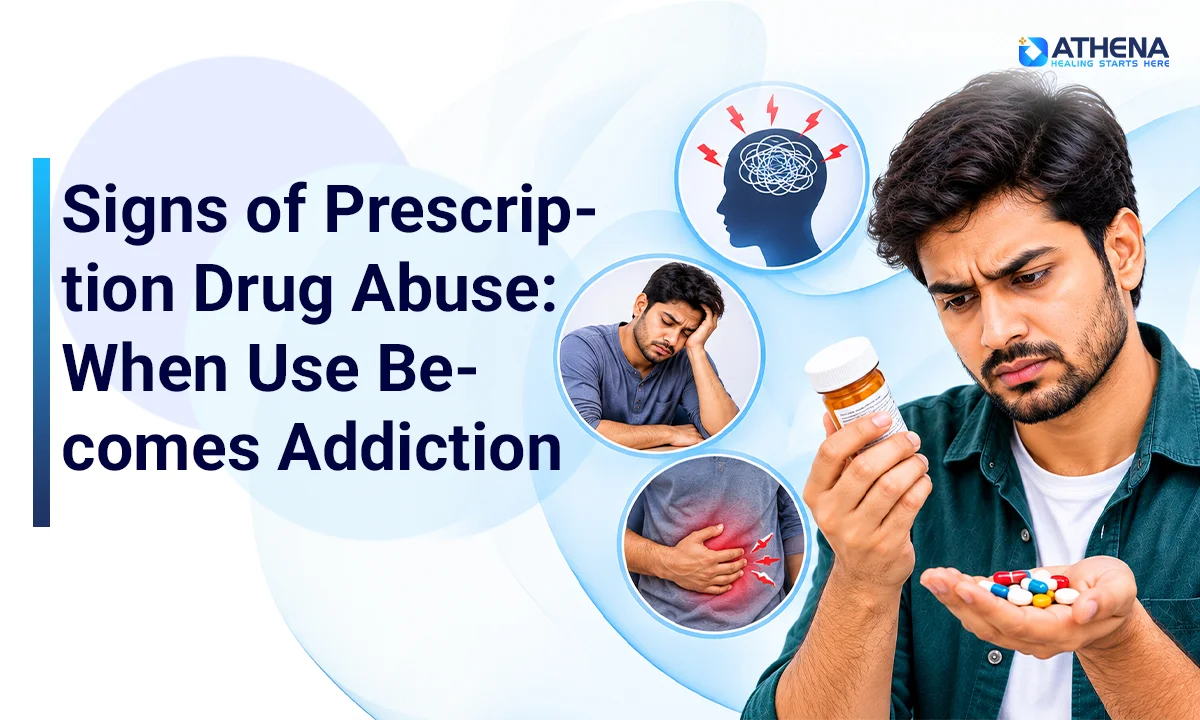

The signs of prescription drug abuse do not usually occur all at once. An individual takes a pill to relieve back pain, stress, or lack of sleep, and it helps. Then he needs another pill on a stressful day, followed by a refill that runs out early, and eventually the drug changes from something used for treatment into something needed.
As the pills have been prescribed by a doctor, it makes it easier to justify for the user and for those around him. The following guide will provide information on the symptoms of prescription drug abuse, difference between abuse and addiction, and steps to be taken after identifying symptoms.
What Is Prescription Drug Abuse?
Prescription drug abuse is the use of a prescribed medicine in a way the doctor did not intend. It does not need illegal activity or a street drug. Taking a larger dose, taking it more often, continuing after treatment should have ended, using someone else's tablets, or using a medicine for the high or to cope with stress all count as misuse.
What Is Prescription Drug Addiction?
Prescription drug addiction, known as substance abuse, is a clinical problem where an individual becomes obsessed with taking drugs even when such behavior negatively impacts their well-being, professional life or relationships with family members. The brain gets accustomed to the effects of drugs so that one requires larger doses of medication in order to feel better. Addiction can be cured, but it is hardly ever overcome through will power alone.
Which Prescription Drugs Are Misused Most Often?
Three groups of medicines account for most misuse. Each changes pain, mood or alertness, and the brain quickly learns to seek that effect.
Drug types | Examples | Why people misuse it |
Opioid painkillers | Tramadol, codeine, oxycodone | Pain relief, a feeling of calm |
Sedatives and anti-anxiety medicines | Alprazolam, clonazepam, diazepam | Sleep, escaping anxiety |
Stimulants | Methylphenidate, amphetamine-based ADHD drugs | Focus, energy, staying awake |
Common Signs of Prescription Drug Abuse
One sign on its own does not prove a problem, since anyone can misplace a strip of tablets or have a rough week. What matters is a pattern. The common signs of prescription drug abuse fall into three areas.
Changes in behaviour
Tablets running out well before the refill date.
Repeated stories about lost or stolen prescriptions.
Visiting several doctors or chemists for the same medicine.
Hiding pills or becoming defensive when asked about them.
Missing work, classes or family plans.
Changes in the body
Drowsiness, slurred speech or nodding off mid-sentence.
Constipation and very small pupils with opioids.
Clumsiness, confusion and memory gaps with sedatives.
Weight loss, a racing heartbeat and sleeplessness with stimulants.
Changes in mood
Sudden irritability or anger
Panic or restlessness when a dose is missed
Losing interest in people and hobbies that once mattered
Warning Signs of Prescription Drug Abuse in Adults
Misuse of the medication is often well concealed by adults who continue their job and daily activities for many years relying on the tablets without letting anybody know. The warning signs are hard to spot in such cases.
The following should be considered:
Taking medicines to cope with stress, grief or isolation, rather than the initial condition;
Combining medications with alcohol consumption in order to relax;
Financial issues caused by the purchases of excessive pills;
Errors, late arrival and lack of concentration during work;
Anxiety when there are not enough pills left.
Patients with chronic pain, insomnia, anxiety or ADHD run the greater risk due to constant availability of such pills. Depression is also an additional factor – a recent JAMA Network Open article states that the probability of developing the disorder among depressed young people was four times as high.
How Common Is Prescription Drug Abuse?
Far more common than most families assume. In the US, the 2024 national survey by SAMHSA found that 13.8 million people aged 12 and older misused prescription drugs in a year, about 4.8% of that age group. Around 7.6 million of them misused opioids and 4.6 million misused tranquilizers or sedatives. The full survey results are published by SAMHSA, the US government's substance use and mental health agency.
India shows a similar pattern. The AIIMS national survey reported that 0.96% of people aged 10 to 75 use pharmaceutical opioids, and about 1.18 crore people take sedatives without a prescription.
Drug Abuse vs Drug Addiction: What Is the Difference?
The two terms are often used as if they mean the same thing, but they describe different stages. Misuse is something a person does. Addiction is what follows when the brain and body adapt so heavily that stopping feels impossible.
Features | Drug abuse | Drug addiction |
Control | Can usually stop if they decide to | Cannot stop even when they want to |
Reason for use | Chasing an effect or relief | Avoiding withdrawal, feeling normal |
Body | Tolerance may begin | Strong tolerance and withdrawal |
Daily life | Occasional problems | Health, money and relationships suffer |
Doctors assess this using 11 criteria. Meeting two or three suggests a mild disorder, four or five moderate, and six or more severe.
When Does Prescription Drug Use Become Addiction?
The shift is gradual. First the body needs more of the drug to get the same effect, then it needs the drug just to feel normal. A few honest questions can show where you stand.
Do I feel sick, shaky or anxious when I miss a dose?
Have I tried to cut down and failed?
Do I spend a lot of time thinking about my next dose?
Am I still using it even though it is hurting my health or relationships?
Two or more "yes" answers are a good reason to speak to a doctor. Please do not stop opioids or sedatives suddenly on your own. Withdrawal from these drugs can be painful and, with sedatives, even cause seizures, which is why many people begin with medically supervised detox instead of quitting alone.
What Are the Signs of a Prescription Drug Overdose?
An overdose can happen faster than families expect, especially when tablets are combined with alcohol. Recognising the signs can save a life.
Call 112 straight away if you notice:
Slow, shallow or stopped breathing
Blue or grey lips and fingertips
No response when you try to wake the person
Gurgling or choking sounds
A seizure or chest pain
Never wait for the person to sleep it off.
How Do You Talk to Someone Who May Be Misusing Medication?
Initiate the discussion during a time when the individual is not angry and is sober, and in a private place. Discuss your concerns out of care and not anger, for instance, "I see that you look tired and I am concerned." Do not use names but focus on observable behaviors, and then give a solution such as taking them to see a doctor. Expect denial and hence repeat the discussion.
How Is Prescription Drug Addiction Treated?
The process of recovery is an optimal step-by-step process that includes evaluation of the substance, dosage, duration of the use of the substance, and presence of anxiety, depression, or pain at the initial stage of the process of recovery. The next step in the recovery process is detoxification and then psychotherapy is performed.
Families often ask what a full programme looks like. A good prescription drug addiction treatment plan combines medical care, counselling and aftercare under one team, so the person is not passed between providers. Many programmes also add mindfulness and yoga sessions, which help calm the nervous system, ease cravings and build habits that hold up after discharge.
About Athena Behavioral Health
Athena Behavioral Health is a behavioral health care service that is based on one very simple principle, and that is the fact that people recover much better when they are treated as individuals, and not just cases.
Everything about the treatment will revolve around your personal background, physical health, and your goals, as the medical professionals, psychologists, and specialists of wellness will work in close cooperation to make this happen. Families are always welcome, privacy is ensured, and the emphasis is put on sustainable health improvement, and not on quick fixes.