
You brought a baby home and expected to feel happy. Instead you feel flat, weepy or on edge, and you keep telling yourself it will pass. For many women it does not pass on its own. Postpartum depression affects about 1 in 5 mothers in India, yet only a small share ever get proper treatment. It is a medical condition with clear causes and effective treatment. Below you will find the signs to watch for, what drives it, who is more likely to develop it, and how recovery works.
What Is Postpartum Depression?
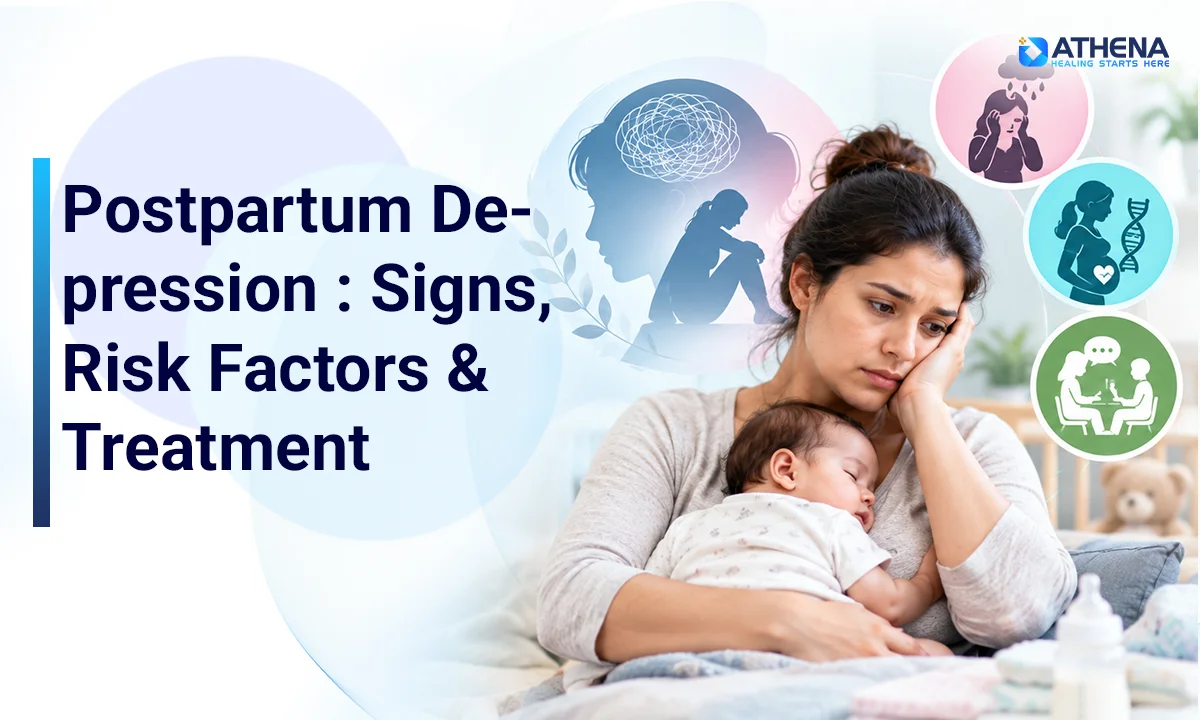
Postpartum depression (PPD) is a form of depression that occurs after childbirth. This may happen during the first few weeks of post-delivery or even within one year after giving birth, and in some cases, the condition may extend into depression that started during the pregnancy period. PPD is just one aspect of postpartum mental health issues, which includes anxiety and other serious conditions. According to the World Health Organization, there is a need for health services to integrate the issue of maternal mental health into standard care. Statistics include:
Approximately 17% of all mothers globally have PPD, according to research in 565 studies from 80 countries.
About 22% of Indian mothers, according to a meta-analysis from the WHO Bulletin.
Only about 10% of the women who suffer get evidence-based care.
Baby Blues, Postpartum Depression and Psychosis Compared
A low mood in the first days after birth is common, and it is not always PPD. The table shows how the three conditions differ.
Basis | Baby Blues | Postpartum Depression | Postpartum Psychosis |
How common | Up to 3 in 4 mothers | About 1 in 5 mothers in India | About 1 to 3 per 1,000 births |
Starts | First few days | Weeks to 12 months after birth | Usually within 4 weeks |
Lasts | 1 to 2 weeks | Months, longer if untreated | Needs urgent care |
What helps | Rest and reassurance | Professional treatment | Emergency treatment |
Timing and intensity usually settle the question. If tears and mood swings ease within two weeks, you are likely dealing with baby blues rather than postpartum depression. If the heaviness stays or grows, treat it as PPD and speak to a doctor.
Signs and Symptoms of Postpartum Depression
The manifestations and symptoms of postpartum depression can be easily dismissed as fatigue. If some of the following persist for more than two weeks, then they should be noted:
Feelings of sadness and loneliness most of the time.
Lack of interest in activities that were previously enjoyed, as well as the baby.
Feelings of guilt or the sensation of being a bad mother.
Constant fatigue despite sleep, or difficulty falling asleep even when the baby falls asleep.
Experiencing extreme increase or decrease in appetite.
Being irritable, angry, or prone to crying.
Avoiding social contact with friends and family.
Difficulty concentrating or decision-making.
Feeling disconnected from your baby.
Some women will notice symptoms of postpartum depression manifest physically, through headaches, body pains or digestive problems without any medical reason.
Postpartum Anxiety: Symptoms Often Overlooked
Depression and anxiety often appear together after birth. The symptoms of postpartum depression and anxiety include:
Racing thoughts that will not slow down
Constant fear that something will happen to the baby
Checking on the baby again and again
Panic attacks with a fast heartbeat, dizziness or shortness of breath
Restlessness and difficulty relaxing
When anxiety is the strongest symptom, it still counts as a reason to ask for help.
What Causes Postpartum Depression?
The next question that moms have is why postpartum depression occurs. Here is the truthful response – there isn’t one. Postpartum depression causes interact with each other in order to create the condition:
Hormonal issues: a sudden drop of estrogen and progesterone levels takes place within 2 days after birth.
Insomnia: several weeks of poor sleep leave you vulnerable to stress.
Physical healing: pain after cesarean section or other medical interventions, breastfeeding problems, changes in thyroid gland.
A new identity: physiological and psychological changes, as well as expectations from your part.
Not enough assistance: most women feel that they should heal quickly and run the whole house.
Nothing here has been caused by your actions or lack thereof.
Postpartum Depression Risk Factors
Any mother can develop PPD, but some postpartum depression risk factors make it more likely.
General Risk Factors | Seen Often in Indian Studies |
Past depression or anxiety | Financial difficulty |
Depression during pregnancy | Domestic violence |
Family history of depression | Conflict in the marriage |
A traumatic or difficult birth | Little support from the husband |
Age under 24 | Pressure linked to having a girl child |
Breastfeeding problems | Earlier psychiatric illness |
Grief adds to the risk. Mothers who have lost a pregnancy can carry trauma and depression after a miscarriage into a later pregnancy or birth, and they often need extra support at that stage.
Why Postpartum Depression in New Mothers Often Goes Unnoticed
As far as postpartum depression in young mothers goes, the greatest challenge will always be the fact that people do not talk about it. Mothers do not want to seem crazy, family members consider it normal, and post-partum appointments revolve around how many stitches you have and how much you weigh. PPD can go on for months and years without treatment, and it can impact bonding and development.
Postpartum Depression Treatment: What Works
Most mothers recover well with the right postpartum depression treatment. The choice depends on how severe the symptoms are.
Options | Suits | What Happens |
Talk therapy | Mild to moderate PPD | Regular sessions to work through guilt, fear and exhaustion |
CBT | Mild to moderate PPD | Structured sessions that change unhelpful thought patterns |
Medication | Moderate to severe PPD | Antidepressants prescribed by a psychiatrist |
Daily therapy programme | When weekly visits are not enough | Therapy every day while you sleep at home |
Many women start with psychotherapy and counselling, which gives them a private space to say what they have been hiding. When symptoms are heavier and weekly appointments fall short, a day-care programme adds daily structure without a hospital stay.
Cognitive behavioral therapy for postpartum depression is about learning how to identify unhelpful thoughts such as "I am a bad mother" and see whether they are based on reality. Meta-analysis research showed that cognitive behavioral therapy reduced Edinburgh Postnatal Depression Scale scores significantly more than usual care in the immediate post-intervention period as well as later on. In a study from Hong Kong involving 388 couples, couples-based cognitive behavioral therapy reduced the proportion of mothers exceeding the cut-off for depression by 17.8 percentage points relative to non-cognitive behavioral therapy condition.
When using medication: there are certain antidepressants that are safe for use while breastfeeding, but ultimately this decision is up to your psychiatrist.
Depression Treatment for Women in Gurgaon: Athena OKAS
Some mothers recover better away from daily demands, in a calm space where they can talk freely. Athena Behavioral Health runs Athena OKAS in Sector 39, Gurgaon, a residential centre built for women only. It offers depression treatment that looks at the whole picture of a woman's life, including pregnancy, the postpartum period and hormonal changes. Care here covers:
Postpartum and Perinatal depression, anxiety, and low moods associated with trauma.
An all-women team of psychiatrists, therapists, and nurses.
Care tailored to suit your hormonal cycle and your own past.
Daily psychiatric evaluation in the first few days, as well as individual and group therapy.
24 hour nursing, private rooms, and meals made at home.
Maximum confidentiality, nothing is shared with family and employers without your written permission.
Typical stays range from 30 to 90 days based on the recommendation of the psychiatrist.