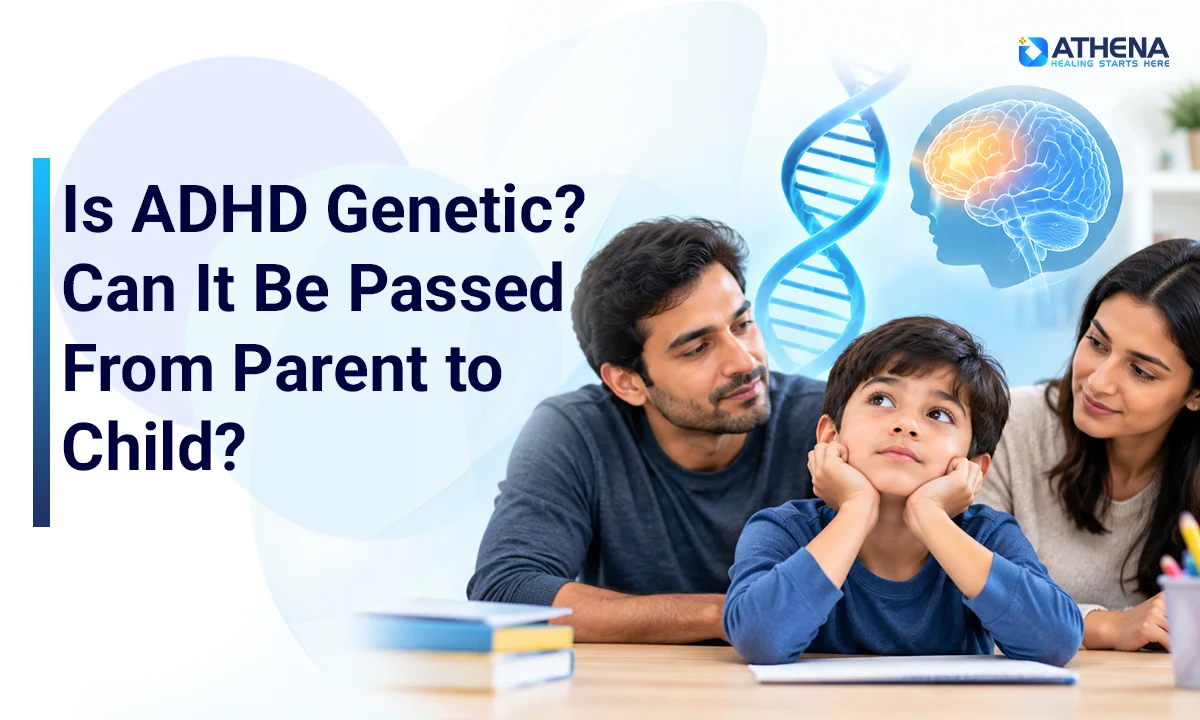

Is ADHD genetic? Yes, and it is one of the most inherited mental health conditions. Twin studies put its heritability at about 74%, so genes explain most of the difference in who develops it. Many parents ask whether ADHD is hereditary right after a child's diagnosis, and many adults ask the same thing when they recognize their own lifelong struggles with focus, restlessness or messy routines in their child.
Inherited risk is not definitive, however. While it increases the risk of having ADHD, it is not a determining factor. There are plenty of individuals who have ADHD with no previous family history and the disorder is treatable. This article will explain the role that inheritance plays, other factors involved and the next step.
What Is ADHD?
Attention-deficit/hyperactivity disorder (ADHD) is a neurodevelopmental condition. It affects how the brain handles attention, activity levels and impulse control. It is not laziness, and it is not caused by weak parenting.
ADHD shows up in three patterns:
Mainly inattentive: trouble holding focus, forgetfulness, lost belongings.
Mainly hyperactive-impulsive: constant movement, interrupting, acting before thinking.
Combined: both sets of symptoms together.
Around 5-7% of children and about 2.5% of adults worldwide live with ADHD.
Is ADHD Genetic or Hereditary?
ADHD is both genetic and hereditary; the risk lies within the individual's genes and runs in families. There are three types of researches which confirm it:
Twin research: if one identical twin suffers from ADHD, the second one will be at much greater risk of having it than his or her fraternal twin sibling.
Family researches: ADHD risk among parents and siblings of an ADHD-sufferer is very high.
Adoption researches: adopted children display symptoms which resemble those of their biological parents rather than their adoptive ones.
Then, does the presence of a genetic factor cause ADHD? This factor is the most influential one, although not the only one.
ADHD Genetics in Numbers
Measures | Figures |
Heritability (twin studies) | About 74% |
Children with ADHD worldwide | Around 5-7% |
Adults with ADHD | Around 2.5% |
Higher risk for close relatives | About 5-9 times |
Boys vs. girls diagnosed in childhood | Roughly 2 to 1 |
Is ADHD Inherited From the Mother or the Father?
This can come from one or both parents. Attention deficit disorder does not pass primarily through the maternal line or the paternal line, and the myth that it passes through the mother's line is false. Attention deficit disorder is not linked to a single gene or chromosome.
When investigating family medical history, consider more than the immediate parents:
Brothers or sisters, cousins, uncles and aunts with trouble focusing or controlling impulses.
Grandparents who were always fidgety or labeled as careless.
Family members treated for anxiety or depression that might have been masking ADHD.
If both parents have attention deficit disorder, the likelihood increases even more.
Which Genes Are Linked to ADHD?
No single "ADHD gene" exists. ADHD is polygenic, meaning thousands of small gene variations each add a tiny bit of risk. Many of these genes affect brain development and the way nerve cells signal each other, including dopamine pathways tied to attention and motivation.
That is why two people with the same diagnosis can look very different from one another. One may be restless and talkative, the other quiet and forgetful.
Can You Have ADHD Without a Family History?
Yes, An empty family tree does not rule ADHD out. Common reasons include:
Older generations were rarely assessed, especially women and girls
Some relatives showed it as anxiety, irritability or disorganization
Non-genetic factors can raise risk without any inherited link
Genes vs. Environment: What Else Raises ADHD Risk?
Genes set the starting point, and early life can shift it. This table separates what research supports from what it does not.
Linked to higher ADHD risk | Common myths, not proven causes |
Premature birth or low birth weight | Eating too much sugar |
Smoking or alcohol during pregnancy | Screen time alone |
Early lead or toxin exposure | "Bad parenting" |
Early head injury | Lack of discipline |
These myths leave parents feeling guilty and delay treatment. Many other wrong ideas about attention and mood conditions are cleared up in this piece on mental health misconceptions.
Signs and Symptoms of ADHD
Common signs of ADHD in children:
Zoning out in class or during conversations
Trouble following instructions with several steps
Fidgeting and difficulty staying seated
Blurting out answers or cutting in on others
Big reactions to small frustrations
Common signs of ADHD in adults:
Running late and missing deadlines
Trouble planning, prioritizing and finishing tasks
Restlessness felt inside rather than seen
Impulsive spending or quick decisions
Feeling constantly behind
Doctors look for symptoms that began before age 12, appear in more than one setting such as home and school or work, and clearly get in the way of daily life.
ADHD in Children vs. ADHD in Adults
Basis | Children | Adults |
Typical presentation | Visible hyperactivity, school problems | Inner restlessness, disorganization, burnout |
Who gets noticed more | Boys | Often women, diagnosed later |
Common trigger for evaluation | Teacher or parent concern | Work stress or a child's diagnosis |
Estimated prevalence | 5-7% | About 2.5% |
Many parents see their own history in this table. For a plain walkthrough of the condition from symptoms to treatment, read this guide on what ADHD is and how it shows up.
Is There a Genetic Test for ADHD?
There is no genetic test that can detect whether one has ADHD through genetic markers. Researchers have employed "polygenic scores" in studies to determine risk in populations, but polygenic scores only represent a small fraction of those individuals that will have ADHD and thus cannot be used to predict it in individuals.
The diagnosis is made by a clinician through evaluation of your history and symptoms as well as other diseases which may mimic ADHD. A psychiatric assessment and diagnosis covers all of that in one visit. For official background on the condition, you can also look at the National Institute of Mental Health.
ADHD Treatment and Therapy That Work
Treatment helps whether or not the ADHD was inherited. Most plans mix a few of these:
Medication, prescribed and monitored by a psychiatrist.
ADHD therapy, such as cognitive behavioral therapy, skills coaching and parent training.
Daily habits: regular exercise, steady sleep and simple routines.
Accommodations at school or work, like written instructions and extra time.
Talk-based care is often the piece that makes the other steps stick. Options are listed under psychotherapy and counselling.
ADHD, Stress and Panic: The Link Many People Miss
People with ADHD struggle more than others to be on par with the rest, and this becomes increasingly difficult over time. In many cases, individuals become stressed out, have their thoughts race, and experience panic attacks. Anxiety, left untreated, further exacerbates the issue with attention.
When anxiety is part of the picture, it needs treatment alongside the ADHD care. Approaches for anxiety disorder treatment can lower the daily tension that makes focus harder.
How Athena Behavioral Health Supports ADHD Treatment
ADHD treatment at Athena Behavioral Health is centered on the impact that stress and panic have on concentration, mood, and daily activities. Most individuals arrive thinking that their difficulty concentrating is the sole problem, only to discover later that their symptoms are exacerbated by chronic stress and panic attacks. It is in addressing both that makes the difference.
What that looks like in practice:
Stress control: simple skills to slow racing thoughts and ease overload before it builds.
Panic management: tools to handle sudden spikes of fear, backed by panic disorder treatment when attacks are frequent.
Focus and routine support: practical ways to plan your day, manage time and finish tasks.
Family guidance: help for parents who recognize their own ADHD after a child's diagnosis.
The aim is a calmer mind, steadier focus and a plan that fits your life.