
I remember a mother sitting across from our care team, twisting her dupatta in her hands, saying her son had stopped joining the family for dinner. He would just disappear into his room, and for weeks she assumed it was a passing phase. A neighbour had suggested trying homeopathic treatment for depression before things got worse, something gentle that wouldn't need a hospital visit. We hear versions of this story often at Athena Behavioral Health, because depression rarely announces itself loudly, and people naturally start looking up homeopathic remedies for depression before considering anything more clinical.
This article looks honestly at what homeopathic treatment for depression claims to do, what the research actually shows, and where professional, evidence-based care needs to take over.
What Is Depression
Depression is a medical condition, not simply low mood. It affects sleep, appetite, concentration, energy, and the ability to enjoy everyday life. Common signs include:
- Persistent sadness or a feeling of emptiness lasting most of the day
- Loss of interest in activities that were once enjoyable
- Changes in sleep, either too much or too little
- Fatigue or low energy most days
- Difficulty concentrating or making decisions
- Feelings of guilt or worthlessness
- In severe cases, thoughts of self-harm or suicide
Because depression can range from mild to severe, the right treatment depends on an accurate diagnosis, not on trial and error at home. This is especially true for younger people, whose symptoms can look different from adults. Our article on the signs of depression in Indian teenagers covers this in more detail.
Homeopathic Treatment for Depression
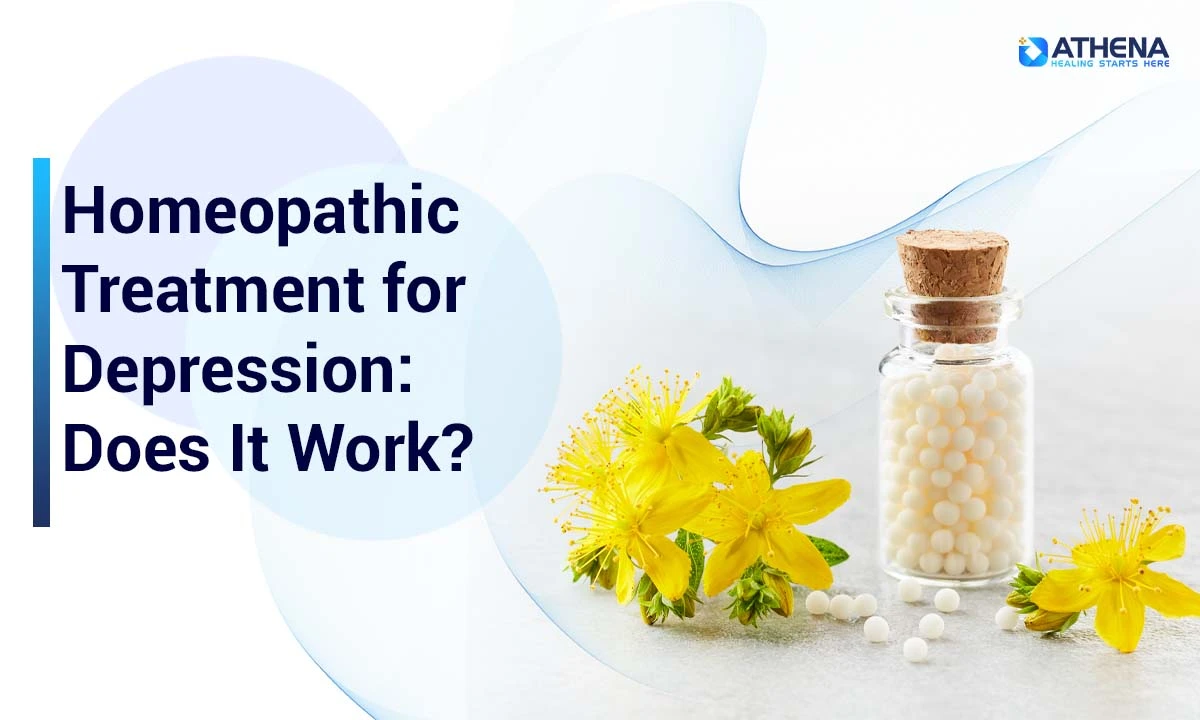
Homeopathy is a system of alternative medicine based on the idea that a substance capable of producing certain symptoms in a healthy person can, in a highly diluted form, treat similar symptoms in someone who is unwell. A homeopathy doctor for depression usually spends time understanding a person's emotional history, sleep pattern, appetite, and personality before selecting a remedy.
Principle | What It Means in Practice? |
Individualisation | The remedy is matched to a person's unique symptom pattern, not a standard diagnosis |
Minimum dose | Remedies are prepared in extremely diluted forms |
Whole person approach | Emotional, physical, and lifestyle factors are considered together |
Longer consultations | Sessions often focus heavily on personal and emotional history |
Homeopathic Medicine for Depression
The term homeopathic medicine for depression usually refers to individual remedies selected on the basis of a person's specific emotional and physical symptom pattern, rather than a fixed prescription used for everyone. This is a key difference from conventional psychiatric medication, which is prescribed based on standardised diagnostic criteria and dosage guidelines established through clinical trials. Because homeopathic medicines are chosen this individually, their effects are harder to study and compare across large groups of people, which is part of why the research base remains thin.
Homeopathic Remedies for Depression
People searching for homeopathic remedies for depression often come across the same few names repeatedly. These are mentioned here for information only, not as a recommendation, since choosing a remedy without professional guidance is not advisable for a condition as serious as depression.
- Ignatia Amara, associated with grief, emotional shock, or recent loss
- Natrum Muriaticum, associated with withheld or internalised sadness
- Aurum Metallicum, associated with deep hopelessness or worthlessness
- Pulsatilla, associated with shifting moods and a strong need for reassurance
Homeopathic Treatments for Depression: Do They Work?
A systematic review published in the journal Homeopathy, summarised by the U.S. National Library of Medicine, found only a handful of small, low-quality trials reporting improvement, with inconsistent designs and often no proper control groups. It concluded that evidence for homeopathy's effectiveness in depression remained limited due to a lack of high-quality trials.
A later review in the European Journal of Integrative Medicine, covering studies from 1982 to 2016, found a small number of placebo-controlled trials showing homeopathic products performing similarly to fluoxetine and, in one lower-bias trial, an advantage over placebo as well. Most other studies had an unclear or high risk of bias. The reviewers called the evidence cautiously encouraging but said more high-quality research is needed. On safety, no evidence of harm was found, with reported side effects being mild and temporary.
Question | What the Evidence Shows |
Does homeopathy cure depression on its own? | Not established. Evidence is limited and inconsistent |
Is it safe to try? | Reported side effects are mild, but safe does not mean effective |
Can it replace therapy or medication? | No. Current evidence does not support this |
Can it be used alongside professional care? | Only with the treating psychiatrist's knowledge and approval |
Many myths around treating depression, whether about homeopathy, therapy, or medication, come from a lack of clear information. It's worth reading about common mental health misconceptions around depression, anxiety, and ADHD to separate fact from assumption.
Homeopathy Depression: A Word on the Bigger Picture
When people search simply for homeopathy depression, they are usually trying to understand whether the entire system is credible for this condition, not just one remedy. The honest picture is that homeopathy as a whole has not been validated by large, high-quality clinical trials for depression. It remains a personal choice some people explore, but it should sit alongside, not in place of, a proper psychiatric evaluation.
Homeopathic Treatment for Depression and Anxiety
Depression rarely shows up alone. Anxiety often accompanies it, which is why homeopathic treatment for depression and anxiety is searched together so frequently. Based on the evidence above, here is a realistic way to think about where it fits:
- It should never replace a clinical evaluation, since depression and anxiety are diagnosed through structured assessment
- It should never substitute prescribed antidepressants or therapy without medical guidance, since stopping evidence-based treatment can allow symptoms to worsen
- It is not appropriate for severe depression, suicidal thoughts, or depression with psychotic features, all of which need immediate psychiatric care
- It can only be considered as a discussed, coordinated addition, with the treating psychiatrist fully aware
Homeopathic Treatment vs Conventional Treatment for Depression
Factor | Homeopathic Treatment | Conventional, Evidence-Based Treatment |
Evidence base | Limited, mostly low-quality trials | Strong, supported by decades of research |
Approach | Individualised remedy selection | Structured diagnosis, therapy, and medication |
Predictability of results | Not established | Clear timelines under clinical monitoring |
Suitability for severe depression | Not recommended alone | Recommended, often first line |
Role at Athena Behavioral Health | Not offered as primary treatment | Core of our depression treatment programme |
When to See a Professional Instead of Self-Treating
Consider professional help immediately if depression symptoms last more than two weeks, interfere with work, relationships, or daily functioning, or if there are any thoughts of self-harm. A homeopathic medicine for stress and depression may feel like a low-risk first step, but delaying proper diagnosis can allow a treatable condition to become harder to manage over time.
How Athena Behavioral Health Treats Depression
At Athena Behavioral Health, we treat depression the way the evidence supports it, through structured, evidence-based psychiatric and psychological care delivered by qualified clinicians. Our depression treatment programme includes:
- Comprehensive psychiatric assessment using standardised diagnostic tools
- Evidence-based psychotherapy, including Cognitive Behavioural Therapy
- Psychiatric medication management, monitored closely when clinically appropriate
- Inpatient, day care, and outpatient options matched to the severity of the condition
- Lifestyle and wellness support built into the overall treatment plan
If you or someone you know is showing signs of depression, a professional evaluation is the safest first step, not a remedy chosen on guesswork.
Conclusion
Homeopathic treatment for depression is something many people consider before turning to professional care, often because it feels gentle and personal at a time when everything else feels overwhelming. But the research is clear on one point: homeopathic remedies for depression have not been proven effective as a stand-alone treatment, and the evidence supporting them remains limited and inconsistent. They may be explored only as a coordinated addition alongside professional care, never as a replacement for it.
Depression is treatable, but it needs an accurate diagnosis and a structured treatment plan, not guesswork. At Athena Behavioral Health, our focus stays on evidence-based psychiatric and psychological care, so that recovery is built on what actually works rather than what feels reassuring in the moment. If you or someone you know is struggling, reaching out for a professional evaluation is the safest and most effective first step.