 WhatsApp
 Emergency
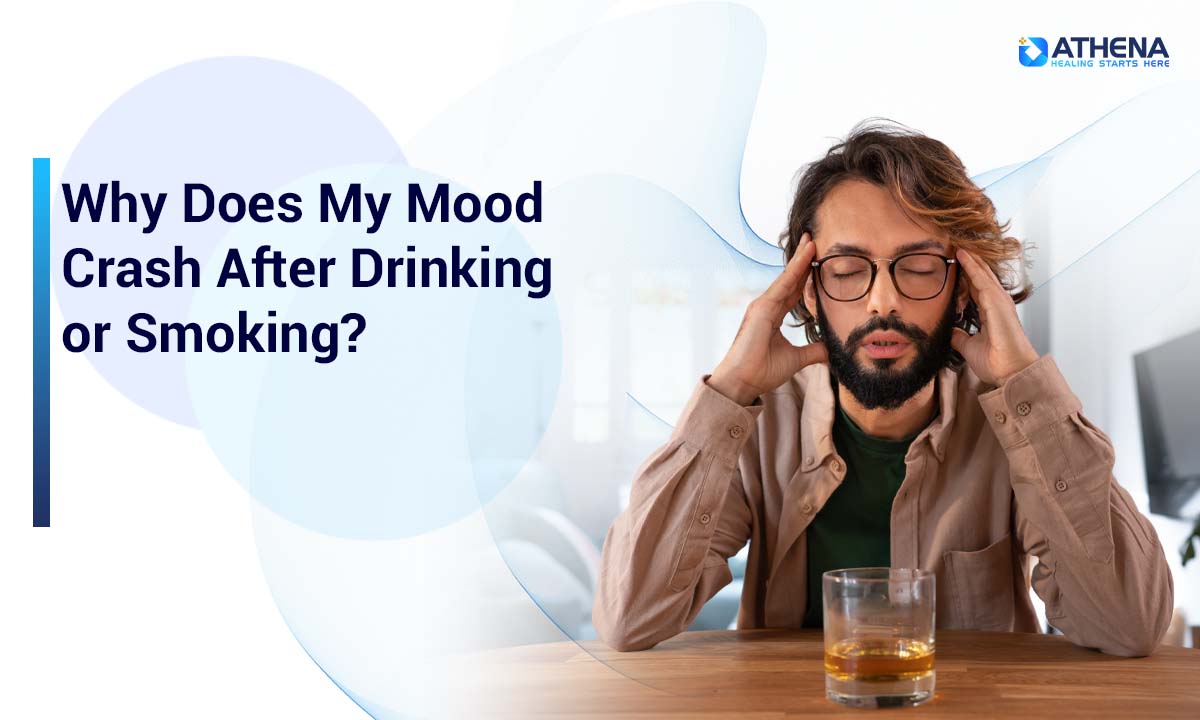
Why Does My Mood Crash After Drinking or Smoking?
 Share
Share
It has a special type of morning-after feeling that is not discussed sufficiently.
It is not the headache itself or the dehydration. It is that silent weight, a feeling of fear, emotional vulnerability, or unaccountable dejection that comes after a drunken night. You replay conversations. You question yourself. You know, sometimes you feel. off.
God knows, you have probably asked yourself, Why does my mood crash after drinking alcohol? Or mood crash after drinking, the name of the phenomenon that is happening to you is hangxiety. And more to the point, it has a biological, psychological explanation. A mood crash after drinking, often called "hangxiety,"
What is Hangxiety?
Hangxiety is not a diagnosis, but it describes something very tangible: The combination of a hangover and an anxiety attack or alcohol and hangxiety. It can feel like:
- A panicky hum in the background.
- Unexpected self-doubt or social regret.
- Disproportionate sensitivity to emotions.
The disturbing aspect is that it is so convincing at the time that nothing is going wrong.
The Brain on Alcohol: Why the Mood Crash Happens
Alcohol does not simply make you relaxed; alcohol changes how your brain is wired, and the emotional price is manifested in the after-effects of alcohol.
The Dopamine Illusion
Dopamine increases when you drink. You are lighter, more open, less turned in.
However, your brain does not maintain that high. It compensates.
The following day, the dopamine level drops below normal.
That flatness you perceive? It is not the weakness; it is neurochemistry self-correcting.
Serotonin Disruption
Serotonin has an important, but silent, contribution to mood stability. It is interfered with by alcohol, and this is the reason why the next day may be:
- Irritability
- Unexpected sadness
- Emotional volatility
This is the reason why some report crying after drinking, although without an obvious stimulus.
A Rebounding Nervous System
Alcohol lowers your nervous system. Upon exiting your system, your body slings back in the other direction. The recovery may seem like:
- Restlessness
- A racing mind
- Physical anxiety (tight chest, uneasy)
Simply put, your body is no longer slowing down, but is a little overcorrected.
Alcohol Depression the Next Day: More Than Just a Mood Crash
Alcohol and depression, or Mood Crash, the next day, may sound like an exaggeration. You may experience: A lack of motivation that is more than just tiredness, A feeling of emotional emptiness, and remorse that seems to be increased beyond actual circumstances.
This does not necessarily have to be what you said or did. It is all about your brain processing and interpreting everything under a chemical imbalance or could lead to dual diagnosis treatment or more .
Why It Feels More to Some People- Hangxiety does not affect everyone in the same manner. Should it strike you more, there is generally a cause.
You Had Changed your Mind- Alcohol does not make people feel anything great- it tends to enhance the feelings. The crash the following day may be even more acute, should you have been under stress or overwhelmed.
Your Sleep Took a Hit- Even 7-8 hours of sleep is interrupted by alcohol, which interferes with deep, restful sleep.
Otherwise, the ability to regulate emotions deteriorates considerably.
You Drank to Cope- When using alcohol to get the edge off, the next day the edge will be even sharper.
Your Brain Is More Fussy to Variations- There are just those who are more sensitive to changes in neurotransmitters, particularly those who have anxiety inclinations.
Comparison: Mood Crash vs Depression After Drinking
| Feature | Mood Crash | Depression After Drinking |
| Cause | One episode of drinking | Repeated use or underlying issue |
| Duration | 1–3 days | Weeks or longer |
| Pattern | Occasional | Persistent |
| Severity | Mild–moderate | Moderate–severe |
| Need alcohol addiction treatment? | Usually no | Often yes |
How Long Does Hangxiety Last?
In the majority of cases, it disappears in a few hours to a day. However, this is based on:
- How much have you drunk
- Your sleep quality
- Your normal cerebral condition.
When the low mood persists over a period of 24-48 hours each time, it is possible that it is borderline on alcohol-induced depression and should be attended to.
How to Reduce/Prevent Hangxiety or Emotional Hangover
You do not require drastic actions, but rather more deliberate ones.
Drink Not With Autopilot- Delaying the intakes and being aware of your limit lessens the intensity of the chemical swing.
In Sleep, Respect More than You Think- One of the most powerful protective factors against anxiety on the next day is quality sleep.
Eating Before and After Drinking- Maintaining a steady blood sugar level has a surprisingly high impact on emotional stability.
Hydration isn’t Optional- Physical and psychological responses to stress are increased by dehydration.
Check Your “Why”
This is the painful yet significant one:
Do you drink to have fun--or to forget?
The solution is usually the predictor of your mood tomorrow.
When Anxiety After Drinking Becomes a Problem
It is typical to have an off day following an alcoholic night. A trend is varied. Pay attention to:
- You get anxious or depressed following a majority of drinking bouts.
- Over time, emotional crashes are increasing.
- Alcohol is starting to be your main coping strategy.
It is not about hangovers at that stage, but rather about your relationship with alcohol and mental health.
Smoking and Mood Swings: How Tobacco Affects Your Emotional Health
The use of tobacco is usually confused as a short-term solution to stress, whereas, in fact, it may increase mood swings in the long run. Nicotine, the main addictive drug in tobacco, is an agent that affects the reward system in the brain, causing a feeling of relief or pleasure in the short term. This effect is, however, temporary and can be followed by irritability, anxiety, and lows.
Once a person starts being a regular smoker, the brain starts relying on nicotine to ensure the levels of the mood are constant. When nicotine level decreases between cigarettes, the effects of withdrawal that include restlessness, frustration, and abrupt moods begin to manifest themselves. It is this cycle of relief and withdrawal that results in emotional ups and downs.
In the long run, the equilibrium of such neurotransmitters as dopamine and serotonin, which are also important in the regulation of mood, may also be affected by tobacco. This can disrupt the chances of feeling anxious, depressed, and generally unstable.
It is significant to learn this relationship. Even though smoking can be relaxing now, it can be part of a greater cycle of mood swings. Cessation of tobacco addiction may aid in regaining emotional stability, enhancing cognitive function, and helping in long-term mental health or could need a dual diagnosis treatment according to symptoms.
Support for Mood Crash after Drinking
When this trend is not new, then support does not need to be extreme, but should be suitable. Options include counseling to learn about emotional triggers and psychiatric follow-up in case of mood symptoms. Patterns may be difficult to change, so structured alcohol addiction treatment or dual diagnosis Treatment programs.
Final Thought
Hangxiety may be very personal, even isolating. However, in most cases, it is a foreseeable reaction to the effects of alcohol on your brain. It is not merely that one understands that, but it also makes the feeling soft. And when you can see the pattern, you are far better placed to make decisions on whether or not you want alcohol to play a role in your life. Contact Athena Behavioral Health, a mental hospital in Gurgaon, at +91 9289086193.