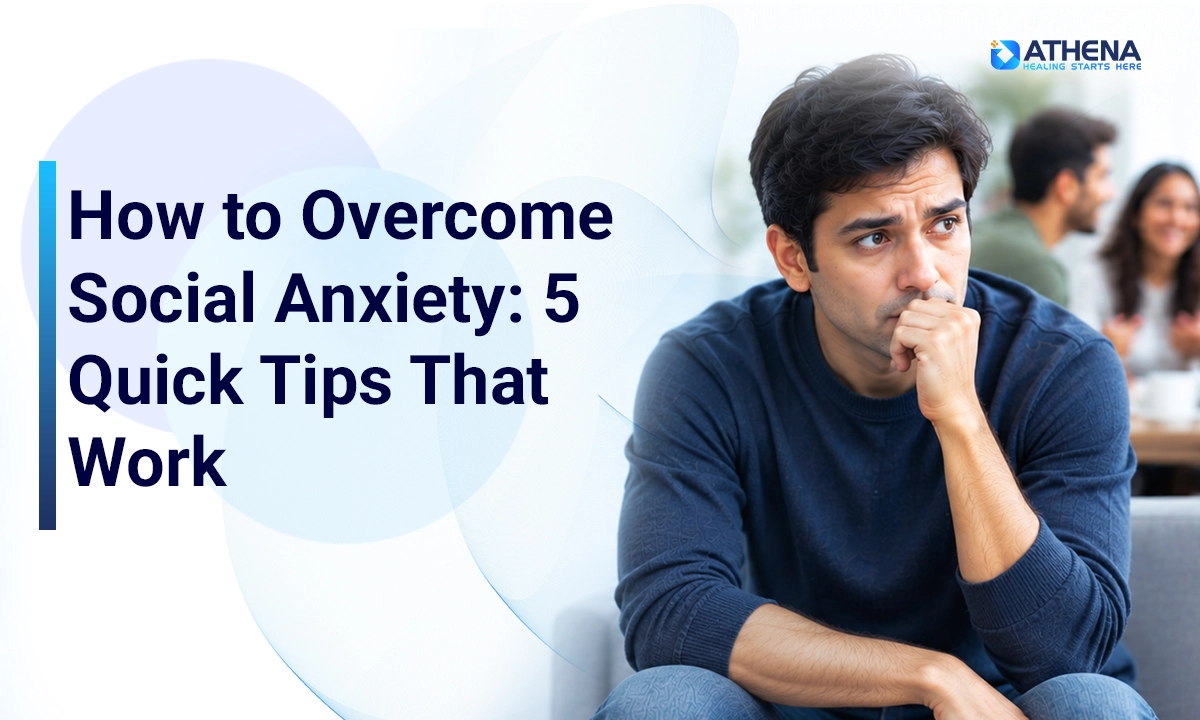

Some people feel their stomach drop when the phone rings. Others practise a two-line introduction ten times, or come up with excuses to skip a family function. If that sounds like you, your personality is not the problem. What you are dealing with is a fear response, and fear responses can be retrained.
This post covers how to overcome social anxiety with five simple tips you can start this week. You will also see the symptoms to watch for, what causes the fear, which treatments work, and when it is time to talk to a professional.
What Is Social Anxiety?
Social anxiety is a strong and lasting fear of being judged, embarrassed or rejected by others. It goes well beyond ordinary nerves before a presentation. A person with a fear of social interaction may dread an event for weeks, avoid it completely, or get through it feeling worn out. When the fear starts getting in the way of work, studies or relationships, it is diagnosed as social anxiety disorder, a common and treatable mental health condition.
How Common Is Social Anxiety? Key Numbers
Social anxiety is far more widespread than most people assume, which means you are in good company.
Facts | What research shows |
Adults affected at some point in life | About 12% |
Typical age when it starts | Around 13 years |
Lifetime rate in teenagers | 11.2% in girls, 7.0% in boys |
People who ever seek treatment | Roughly half |
Usual wait before getting help | 15 to 20 years |
The last row stands out. Many people lose years simply because nobody told them this condition responds well to treatment.
Social Anxiety vs. Shyness: How to Tell the Difference
Many individuals may dismiss their symptoms by attributing them to shyness. This table outlines the differences between the two.
Features | Shyness | Social anxiety disorder |
Intensity | Mild discomfort | Strong fear or dread |
Duration | Fades once you warm up | Builds before and lingers after |
Effect on daily life | Rarely disruptive | Affects work, school, relationships |
Avoidance | Occasional | Frequent and deliberate |
Symptoms of Social Anxiety
Symptoms appear in your mind, your body, and your actions. Symptoms include the following.
Fear of embarrassing yourself or being in the limelight.
Stressful feelings for days ahead of a social gathering.
Going over conversations again and berating yourself afterward.
Becoming blushed, sweaty, shaking, or having a trembling voice.
Feeling heart palpitations, nausea, or a mind going blank.
Avoiding interactions, calls, gatherings, or eating in public.
What Causes Social Anxiety?
It is rarely just one particular cause. Social anxiety usually results from a mixture of different causes.
Genetics: It appears that there is a very strong link between genetics and anxiety.
Brain: This could mean that the brain’s alarm system is overly sensitive to social threats.
Bad experience: Bullying and being taunted; criticism and public humiliation can lead to serious long-lasting results.
Temperament: Alertness and sensitivity make children more prone to such issues.
Patterns of thinking and behavior that maintain the problem: Constantly paying attention to oneself and avoiding certain situations prevents you from understanding that the situations are safe.
This point is quite promising since it can be overcome through behavior changing.
5 Quick Tips to Overcome Social Anxiety
Each of these tips is small enough to try today. Start with the one that feels easiest.
Tip 1: Turn Your Attention Outward
Your anxiety keeps you watching yourself from a critical perspective. Shift the focus from yourself to the other individual. Pay attention to what they say and observe their tone and surroundings. Individuals are likely to underestimate what others think about them because they themselves are preoccupied with making an impression.
Tip 2: Slow Your Breathing
A racing body keeps the mind racing too. Try this one-minute reset:
Breathe in through your nose for 4 seconds.
Breathe out gently through your mouth for 6 seconds.
Repeat five or six times.
Longer exhales tell your nervous system to settle down. For a steadier baseline, daily habits like mindfulness and yoga help many people feel less reactive in situations that used to overwhelm them.
Tip 3: Test Your Negative Predictions
When you believe statements such as “They will find me boring,” you are just making an assumption about reality. Reflect on the following three questions: What am I afraid of? What evidence do I have for this and against this? How would a rational person see it? Five minutes of journaling every day teach your mind not to make incorrect assumptions.
Tip 4: Climb the Fear Ladder
Avoiding a situation helps to cope with fear instantly, but it makes the fear even greater. Confrontation in a step-by-step manner achieves the opposite effect.
Steps | Situation | Difficulty |
1 | Smile or say "hi" to a neighbour | 2/10 |
2 | Ask a shopkeeper for help | 3/10 |
3 | Send a casual message to a colleague | 4/10 |
4 | Join a team lunch | 6/10 |
5 | Share one opinion in a meeting | 7/10 |
6 | Give a short talk | 9/10 |
Do not leave each situation until your level of anxiety reduces. This will happen after 20 to 30 minutes if you do not leave.
Tip 5: Stop Safety Behaviors and Take Care of Your Body
Simple behaviors such as constantly checking on your phone, rehearsing sentences, or leaving early silently fuel the anxiety. Do this in bits. Next, take care of the basic needs that contribute to your level of jumpiness by:
Getting 7 to 9 hours of sleep.
Minimizing caffeine as it has similar symptoms to anxiety.
Walking/ exercising for 20 to 30 minutes on most days.
Avoiding alcohol because it contributes to anxiety in the long run.
How to Deal with Social Anxiety at Work, Parties and on Calls
Putting the tips into real situations is where the change happens. A few starting points:
At work: Prepare one comment before a meeting and say it early, while tension is still low.
At parties: Arrive on time, aim to speak with two people, and ask open-ended questions.
On calls: Jot down three points beforehand and keep a glass of water nearby.
When Should You See a Doctor for Social Anxiety?
Self-help is a solid start, but some situations call for a professional.
Your fear has lasted six months or longer.
You are skipping work, classes or relationships.
You feel low or hopeless, or you have panic attacks.
You rely on alcohol or other substances to cope.
Social anxiety often comes with other conditions, including depression (about 19%). A clinician can sort out what is going on through a psychiatric assessment and diagnosis, which looks at your symptoms, history and daily life before suggesting a plan.
Social Anxiety Disorder Treatment: What Works Best?
Good treatment usually mixes more than one approach.
Options | How it helps | Best for |
Cognitive Behavioural Therapy (CBT) | Changes unhelpful thoughts and builds courage through gradual practice | Most people |
Medication such as SSRIs | Lowers anxiety symptoms | Moderate to severe cases |
Mindfulness and lifestyle care | Reduces overall stress and reactivity | Alongside other treatment |
Your clinician matches these to your needs, and many people recover well with the right anxiety disorder treatment plan.
Social Anxiety Treatment in India
Finding help with social anxiety disorder in India has gotten simpler compared to before. Find a professional psychiatrist or a clinical psychologist, ask whether they provide any therapy that uses scientific proof such as CBT, and ask whether there is the option to have online consultations too. The stigma prevents many people from seeking help.
Why People Choose Athena Behavioral Health for Anxiety Care
At Athena Behavioral Health, we provide treatment for anxiety disorders such as social anxiety using an approach tailored to your needs rather than a set formula. You will never be rushed, and you will never be expected to describe your fears more than once. Here is how we assist you:
A thorough assessment starting from hearing your story.
A customized treatment plan based on your symptoms, lifestyle, and goals.
Therapy based on scientific evidence to alter anxious thoughts and increase self-confidence.
Guidance from a psychiatrist on medication when necessary.
Continuous follow-up where your progress is monitored and your treatment plan is adapted accordingly.
No matter whether you have had many discussions regarding your anxiety or you are having them for the very first time, we will go at your pace.