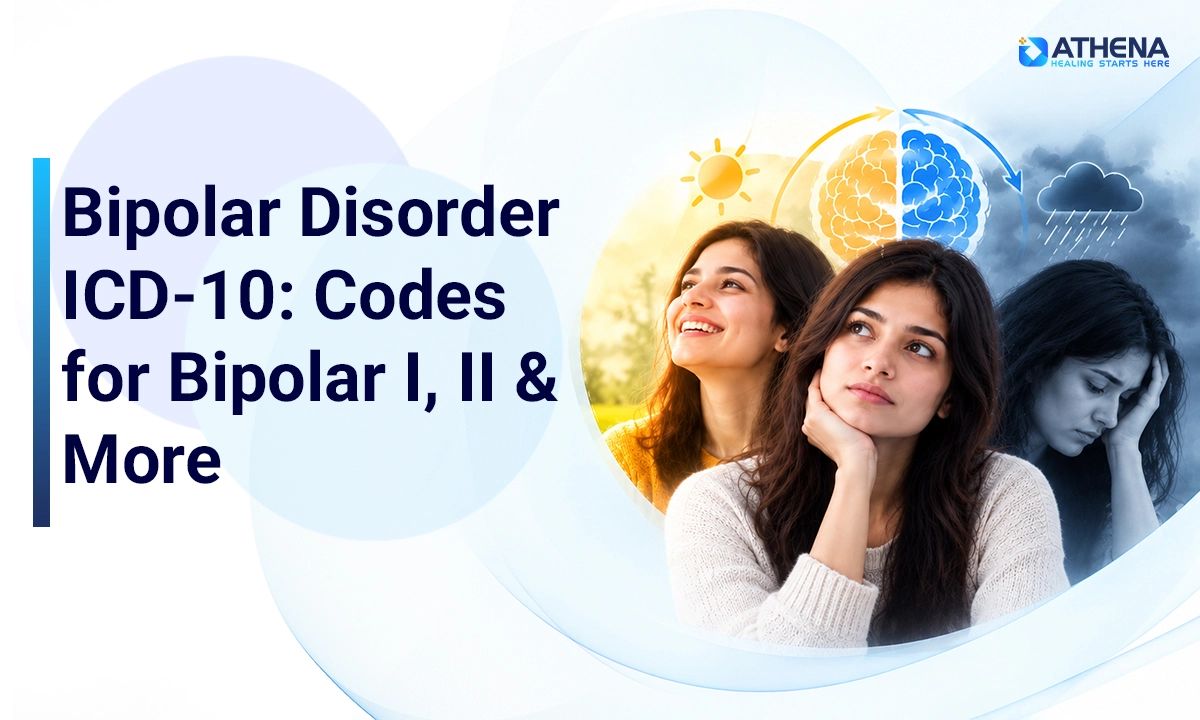

Bipolar disorder is recorded in medical files, insurance forms and hospital reports with a short code, and that code often confuses patients and families. For bipolar disorder ICD-10 uses F31, and the digits that follow show the type and the current phase of the illness. This guide explains each code in simple terms, shows where Bipolar I and Bipolar II fit, and tells you what to do once you have a diagnosis.
What Is the ICD 10 Code for Bipolar Disorder?
ICD-10 code for Bipolar Disorder is F31. The disorder falls under the category of mood disorders ranging from F30 to F39 in the international disease coding system, which is used internationally by doctors and insurance companies to document the diagnosis. The first three codes represent the disease while additional codes give further information, including whether one is suffering from mania or depression.
Bipolar Disorder ICD 10 Codes
Diagnosis | ICD-10 code |
Bipolar disorder, type not specified | F31.9 |
Bipolar 2 disorder | F31.81 |
Other bipolar disorder | F31.89 |
Bipolar 1, hypomanic phase | F31.0 |
Bipolar 1, manic phase | F31.1x, F31.2 |
Bipolar 1, depressed phase | F31.3x, F31.4, F31.5 |
Bipolar 1, mixed phase | F31.6x |
Bipolar disorder in remission | F31.7x |
What Is Bipolar Disorder?
Bipolar disorder is a mood condition in which a person swings between periods of unusually high energy and periods of deep low mood. These are not ordinary ups and downs. The highs can mean days without sleep, racing thoughts and risky decisions, while the lows can bring exhaustion, hopelessness and loss of interest in everything. The episodes can last for weeks or months and often disrupt work, studies and relationships. A detailed look at the warning signs and the medicines used is available in this write-up on bipolar disorder symptoms, medicines and treatment.
Bipolar 1 Disorder ICD 10 Codes
Bipolar I is diagnosed when a person has had at least one full manic episode. It does not have one fixed code, because the code describes the phase the person is in right now.
Current phases | Codes | Meaning |
Hypomanic | F31.0 | Elevated mood, milder than mania |
Manic | F31.10 to F31.13 | Mania without psychosis, unspecified to severe |
Manic with psychosis | F31.2 | Severe mania with delusions or hallucinations |
Depressed | F31.30 to F31.32 | Mild or moderate depression |
Severe depression | F31.4, F31.5 | Without and with psychotic features |
Mixed | F31.60 to F31.64 | Manic and depressive symptoms together |
Remission | F31.70 to F31.78 | Partial or full recovery |
As the code depends on the present stage of illness, it will continue to vary with time. For example, an individual who was coded with F31.13 because of the severity of his manic attack may later be coded with F31.76 a year later upon complete recovery.
Bipolar 2 Disorder ICD 10 Code: F31.81
Bipolar II is diagnosed when a person has had at least one hypomanic episode and at least one major depressive episode, but never a full manic episode. Its code is F31.81.
Key points to remember:
F31.81 is a single code, with no mild, moderate or severe versions.
It is different from F31.0, which is a hypomanic phase inside Bipolar I.
The depressive phases are the ones most people notice, so Bipolar II is often mistaken for plain depression.
Depression that keeps returning, or that does not improve with antidepressants alone, is a reason to ask a psychiatrist about Bipolar II.
What Does F31.9 Mean?
F31.9 indicates bipolar disorder, unspecified. This code is employed when bipolar disorder has been established, but no type and no phase have been recorded. Other older codes such as “manic depression” belong to this category as well. It is common for F31.9 to follow the first contact between the patient and the psychiatrist. However, once a psychiatrist performs the evaluation, this code will be substituted by another one.
Is Bipolar Affective Disorder the Same as Bipolar Disorder?
Yes. "Bipolar affective disorder" is the term used in the WHO classification and in most Indian hospitals, while "bipolar disorder" is the wording used in American systems. Both are coded under F31. If your discharge summary says bipolar affective disorder, current episode manic, it describes the same condition covered above.
Why Do Bipolar Disorder ICD 10 Codes Look Different in India and the US?
Two versions of ICD-10 are in everyday use, and that is why a code can look different depending on where you read it.
Features | WHO ICD-10 | ICD-10-CM |
Mostly used in | India and most countries | United States |
Number of sub-codes | Fewer | Many more |
Bipolar II | Under F31.8 | F31.81 |
Common wording | Bipolar affective disorder | Bipolar disorder |
If an Indian report shows F31.8 and an American website shows F31.81, they point to the same diagnosis.
Why Your Bipolar Diagnosis Code Matters
While the code may seem like mere paperwork, it has many applications:
Insurance: Claims for your hospitalization and treatments are made with the help of this code, and the Mental Healthcare Act, 2017 in India mandates that insurance providers should cover your mental illness just as much as your physical illness.
Medical history: There is a particular code for your previous episodes.
Certifications: Certificates related to employment and disability hold greater value if there is a clear diagnosis.
Treatment: The kind of treatment and its stage determine the medication and treatment required for you.
The code is merely an identification tag. Your diagnosis is based on a proper evaluation by the psychiatrist.
Common Mistakes in Bipolar Coding
These are the errors patients and clinics run into most often:
Leaving F31.9 on the record long after the type is known
Adding phase details to Bipolar II, which only has F31.81
Using a depression code when the person has a history of mania or hypomania
Forgetting to update the code when the phase changes
Treating the code as the diagnosis, when it is only a record of one
How Common Is Bipolar Disorder?
Statistics | Figures |
People with bipolar disorder worldwide | About 37 million, or 1 in 200 |
Average years of life lost | About 13 |
India, current prevalence | 0.3% |
India, lifetime prevalence | 0.5% |
Lifetime prevalence in urban metros | 0.94% |
Treatment gap in India | 70.4% |
The global estimate comes from the World Health Organization's bipolar disorder fact sheet. The Indian figures come from the National Mental Health Survey. The last number is the most worrying: roughly 7 in 10 people in India with current bipolar disorder were not receiving treatment.
Signs That You Should See a Psychiatrist
Schedule a consultation if you have any of the following symptoms:
Several days of minimal sleep and excessive energy.
Racing thoughts, rapid speech, or grandiose ideas.
Spending, impulsive actions, or poor decisions, especially when they seem out of the ordinary.
Prolonged periods of low mood, tiredness, or feeling hopeless.
A cycle of mania and depression that interferes with work or personal life.
Suicidal tendencies, which require immediate attention.
How Is Bipolar Disorder Treated?
Bipolar disorder is long-term, but it responds well to treatment, and most people do best with a mix of approaches. Medicines such as mood stabilisers form the base, since they settle episodes and lower the chance of relapse.
Therapy covers what medicines cannot. Regular psychotherapy and counselling helps you catch early warning signs, keep a steady routine and repair relationships that were strained during earlier episodes.
Daily habits also count. Sleep is one of the strongest protections against relapse, and calming routines like mindfulness and yoga can help with stress and sleep alongside medical care.
Bipolar Disorder Treatment at Athena Behavioral Health
The Athena Behavioral Health treatment center treats bipolar disorders and other mood disorders by following a treatment plan that is based on the patient and not just the diagnosis mentioned in the report. The treatment begins with a comprehensive psychiatric evaluation that determines the type and phase of the bipolar disorder. From there, our bipolar disorder treatment brings together:
Psychiatric medication plan and follow-up.
Individual counseling and therapy.
Family meetings to help family members understand the illness and assist.
Sleep hygiene and structured routines to avoid a relapse.
Review and adjust the plan according to the patient’s condition.
How to Pick the Best Bipolar Treatment in India
If you need to find out which are the best hospitals for bipolar disorder in India, do not rely on names but try to consider their offer:
Evaluation conducted by an expert in order to find out whether it is Bipolar I or II.
Therapy involving medication, counseling, and lifestyle support.
Follow-ups.
Family involvement.
Confidential setting.