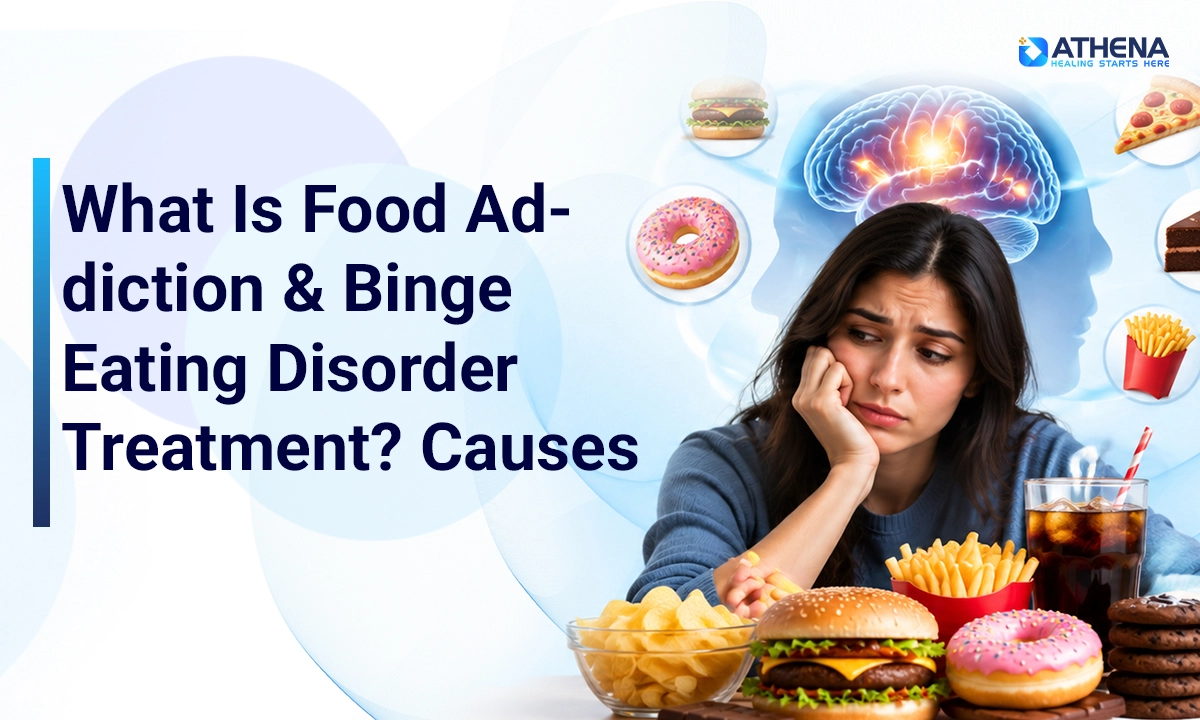

Plenty of people who eat compulsively have already tried strict diets, calorie apps and promises to restart on Monday. When the pattern keeps coming back, they decide they lack discipline. More often, the real issue is food addiction, binge eating disorder (BED), or a mix of both. These are recognised conditions with clear treatment options. This article explains what is food addiction treatment, how to spot the symptoms, what causes them, and what recovery looks like in India.
What Is Food Addiction Treatment?
Food addiction treatment involves the physical and psychological treatment of individuals who have a feeling that they cannot control themselves with regard to eating. This is done by analyzing the causes of their problem, whether it is due to stress, negative mood, restrictive dieting or old eating behaviors, and then teaching them ways to cope with such factors. Most treatment plans involve a clinical assessment, therapy, nutritionist's assistance and an effective relapse prevention plan. This is also the same for binge eating disorders.
How Common Are Food Addiction and Binge Eating Disorder?
These conditions affect far more people than most expect, and many never get help. The figures below give a sense of the scale.
What was measured | Finding |
People in the US who develop BED at some point in life | 2.8% |
BED in a given year, women vs men | 1.6% vs 0.8% |
People with BED who ever receive treatment | Under half |
People meeting food addiction criteria on the Yale scale | Around 20% |
Food addiction among people with binge eating | 55% |
Adults in India meeting the food addiction cut-off (survey of 415) | 32.5% |
Adults screening positive for an eating disorder in Tamil Nadu (350 people) | 23.1% |
The lifetime and yearly BED rates come from the National Institute of Mental Health. The Indian numbers come from questionnaire-based studies, so they point to a pattern rather than confirm diagnoses. Even so, they show this is not a rare problem here.
Food Addiction vs Binge Eating Disorder: How Do They Differ?
Both the concepts have often been used interchangeably by people, and there is indeed considerable overlap between the two; however, a clinician would distinguish between them. The following table highlights the differences between the two.
Basis | Binge Eating Disorder | Food Addiction |
Official diagnosis | Yes, in DSM-5 | No, but studied with the Yale Food Addiction Scale |
Core feature | Repeated episodes of eating a large amount with loss of control | Strong cravings and compulsion toward sugary, salty or fatty food |
Purging afterwards | Not present | Not part of the definition |
Typical experience | Secret eating followed by shame | Needing more for the same comfort, failing to cut down |
Studies found food addiction in 57.6% of people with binge-type eating disorders, against 16.2% in groups without an eating disorder. Because the two so often appear together, the first step is working out which one you are dealing with.
Binge Eating Disorder Symptoms: 7 Signs to Watch For
Binging is distinct from indulging in a sumptuous meal during a wedding function. This is mainly because of lack of control and distress after the act. Some of the common symptoms include:
Consume an excessively huge portion of food within a limited period.
Being unable to stop oneself after having started.
Consuming food much more quickly than normal.
Continuing eating till the physical discomfort starts.
Eating a lot even if one is not hungry.
Eating alone or even keeping food hidden due to embarrassment.
After eating, feeling disgusted, guilty or depressed.
Doctors generally look out for such incidents on a weekly basis for at least three months without vomiting, taking laxatives or over-exercise after.
Food Addiction Symptoms: When Cravings Take Over
Food addiction looks a lot like dependence on other substances. The craving is not just a taste preference, it starts to run the day. These are the usual signs:
Constant cravings for specific foods that are hard to ignore.
Eating far more than planned, over and over.
Needing bigger portions to get the same satisfaction.
Feeling irritable, anxious or flat when you avoid those foods.
Repeated failed attempts to cut back.
Missing social events or work because of eating habits.
Carrying on despite weight gain, acidity, high blood sugar or low mood.
One easy check is to ask whether you decide to eat or feel pulled toward food. If it feels like a pull, you are probably dealing with a habit loop, not a weak will.
What Causes Food Addiction and Binge Eating?
There is rarely one cause. Biology, emotions and daily surroundings usually stack up together. Sugary and fatty processed foods trigger the brain's reward system, which can start asking for more over time. Emotions then keep the cycle going, since stress, loneliness and boredom make food an easy way to switch off. Learning to manage stress and anxiety in other ways can take away some of that pull.
Other common factors include:
Intense dietary restriction or missing meals that increase cravings later on
Depression, anxiety, ADHD or previous trauma
Eating disorder or addiction history in your family
Peer and social media pressure regarding body image
Access to convenient delivery services and prepackaged snacks
Higher among women, older adults over 35 years old and people with obesity. In one review, food addiction affected 26.9% of overweight or obese individuals, but only 14.3% of people who were not obese. However, food addiction can affect any person regardless of weight.
How Is Binge Eating Disorder Diagnosed?
You cannot confirm this with an online quiz, and body weight alone says very little. A trained clinician looks at how you eat, what sets off the urges, your physical health and whether another condition is involved. A proper psychiatric assessment usually takes an hour or more and covers mood, sleep, past trauma, family history and any safety concerns. The result is a plan built around your situation, which matters because it decides which therapy you need and whether medication has a role.
Binge Eating Disorder Treatment: What Works
An effective intervention program impacts on thinking, emotions and behaviour simultaneously. A combination of multiple strategies is used by most programs rather than a single one. The core components include:
Cognitive Behavioural Therapy (CBT): It will help to identify and handle triggers to a binge.
Emotion skills training: Helps to cope with distress not using food.
Nutrition counselling: Assistance of a dietitian in creating proper meal schedules without prohibited food or extreme diets.
Pharmacotherapy: Might be prescribed by a psychiatrist in case of comorbid depression, anxiety or attention deficit hyperactivity disorder (ADHD).
Family therapy: Helpful in case of stress and criticism from family members that cause binges.
Breathing techniques, yoga and mindfulness training: Helps to develop a habit of recognizing the onset of craving, taking a pause and letting it go.
Post-treatment plan: Assists with coping with holidays, travels and stressful weeks.
The extent of help needed depends on severity. Below there is a chart demonstrating typical intensity of intervention.
Levels of care | Who it suits | What it involves |
Outpatient | Mild to moderate symptoms | Weekly therapy, plus visits to a dietitian and psychiatrist |
Day programme | Frequent binges, hard to manage alone | Several structured sessions each week |
Inpatient | Severe symptoms or health risks | Round-the-clock supervised care |
Food Addiction Treatment in India: What to Look For
Both food addiction treatment in India and binge eating disorder treatment in India have improved, but the quality remains inconsistent among different practitioners. Some things to look out for are:
A collaborative team that involves a psychiatrist, a psychologist, and a dietitian.
Therapies like cognitive-behavioral therapy rather than detoxing or quick fixes.
Understanding the Indian food culture which associates meal times with family, celebrations and guilt.
Involvement of the family without any blame.
Option of in-person, day-care, and teletherapy appointments.
Confidentiality
All this needs to be verified during the very first phone call, and you should ask for whom you'll be treated.
Eating Disorder Treatment at Athena Behavioral Health
At Athena Behavioral Health, they have a special program for dealing with food addiction and binge eating. Treatment begins with a lengthy discussion regarding the client’s behavior, thoughts, and psychological state, after which treatment is tailored to the needs of the client. Treatment may include CBT, nutritionist consultations, learning how to cope with challenging emotions, family therapy, medication if the patient suffers from depression or anxiety, and a relapse prevention plan.
Care is available in Gurgaon, Delhi, Greater Noida and Guwahati, including a women-only facility in Gurgaon. You can choose outpatient visits, day care, inpatient stays or online consultations. You can read more about the eating disorder treatment programme before you decide, and every conversation stays confidential.
When Should You Seek Help for Binge Eating?
Many people wait far too long because they feel the problem is not serious enough. A few clear signs suggest it is time to speak to someone:
Binges happen once a week or more.
You feel out of control or very ashamed afterwards.
You have tried to stop on your own several times without lasting change.
Eating is affecting your sleep, mood, health or relationships.
You often feel low, anxious or hopeless.
You do not have to hit a breaking point first. The earlier you start, the easier recovery tends to be.