
You filled out an insurance form, opened a medical report, or searched a clinic's website, and one line stopped you by the roadside: "F43.1." If you are trying to understand what the PTSD ICD 10 code means, then you are in the right place. This article will explain the medical classification, how doctors arrive at a diagnosis, and what is done next.
What Is the PTSD ICD 10 Code?
ICD is the International Classification of Diseases, which is published by the World Health Organization and used by clinicians and hospitals worldwide to describe conditions in a standardized way.
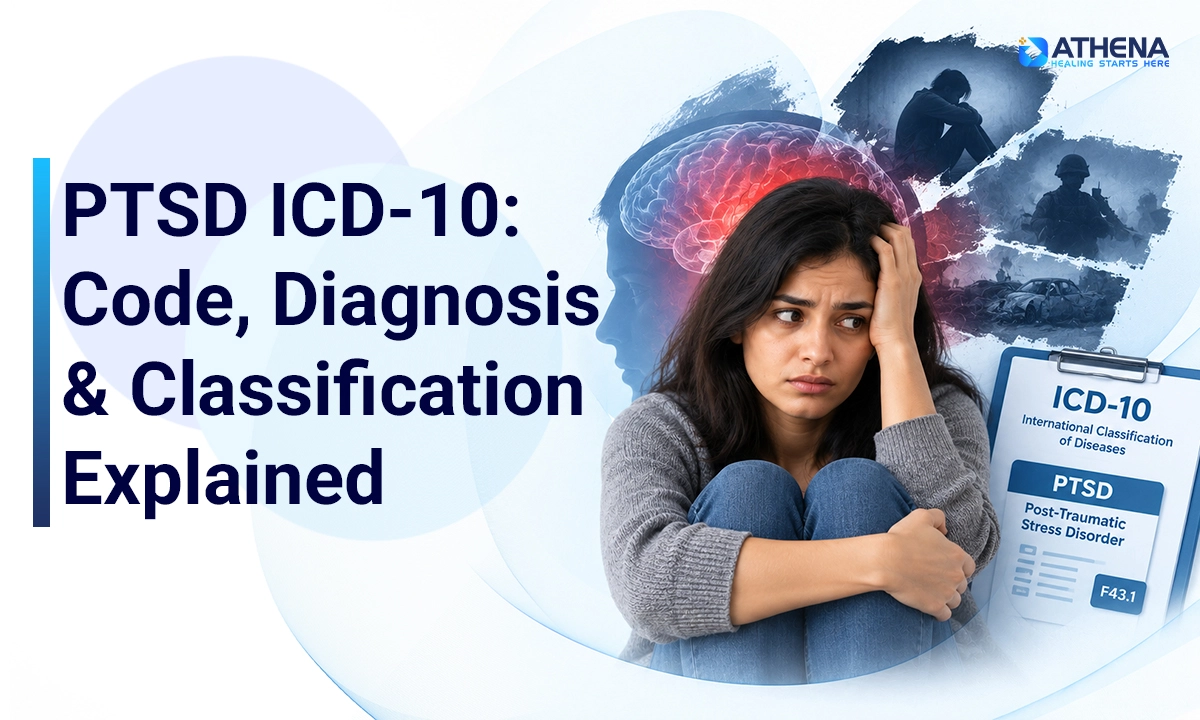
In ICD-10, post-traumatic stress disorder falls under the code F43.1, which relates to "reaction to severe stress and adjustment disorders" (F43). The term may be found as "ICD 10 PTSD" or "ICD for ptsd," but the code itself is F43.1.
PTSD is a relatively common diagnosis: according to the WHO World Mental Health Surveys, the disorder's lifetime prevalence across the world is approximately 3.9% in the general population and 5.6% among people exposed to trauma. In India, the National Mental Health Survey revealed that roughly 1 in 7 people has a mental health problem, making the country's citizens vulnerable to PTSD and adjustment disorders.
ICD-10-CM Codes for PTSD: What Changes in the US Version?
The ICD-10-CM is the clinical modification used in the United States. It splits PTSD into more specific codes, which is why people search "ptsd icd 10 cm" and "ICD 10 diagnosis code for PTSD."
Code | Meaning | Used When |
F43.10 | PTSD, unspecified | Symptoms fit PTSD, but the stage is not recorded |
F43.11 | PTSD, acute | Symptoms last under 3 months |
F43.12 | PTSD, chronic | Symptoms last 3 months or longer |
F43.1 | PTSD (WHO ICD-10) | General classification, no sub-types |
So if you wonder about the ICD 10 PTSD chronic code, it is F43.12. The chronic post-traumatic stress disorder ICD 10 entry applies when symptoms continue for three months or more after the trauma.
How Does ICD-11 Classify PTSD Now?
The latest version of the ICD, ICD-11, uses 6B40 for PTSD and 6B41 for complex PTSD. The latter is applied to cases when patients suffer from prolonged or repeated traumatic events like abuse. However, since India uses ICD-10 for insurance and record-keeping, the diagnosis F43.1 remains in use.
Top 5 Signs of PTSD Claimed by Doctors
Unlike a physical exam, during which a physician might take blood tests and analyze the results, a diagnostic evaluation for PTSD begins with an interview. A psychiatrist or clinical psychologist asks the patient if they experienced a traumatic event and if they have symptoms from four criteria groups.
Reliving the event: having flashbacks, nightmares, uncontrollable memories
Avoidance of reminders: people, places, and activities associated with the trauma
Negative mood changes: hopelessness, detachment, guilt, and loss of interest in life
Sleep disturbance: Inability to sleep, being easily startled, or being angry
Symptoms of PTSD must last more than one month and disrupt work, study, or relationships. Clinicians often use tools such as the PCL-5 questionnaire to measure severity.
Who Gets PTSD, and How Common Is It?
Trauma can occur to anyone: an accident, assault, combat, domestic abuse, or even a natural disaster or loss can precipitate it. Women are more likely to develop PTSD (about 8%) than men (about 4%). Moreover, the disorder is more likely to occur in children, in people who have previously experienced stress, and those who turn to alcohol and drugs to cope. It is crucial to note that many people living with PTSD resort to substance abuse as a coping mechanism, which frequently leads to addiction.
Why Does the Right PTSD Diagnosis Code Matter?
A correct code is much more than a placeholder. Here are four benefits:
Treatment plans are clearer: With the code, the medical team knows the patient's stage of illness and treatment.
Insurance companies pay out faster: They have a specific diagnosis to go off of, so there's less chance they'll deny the claim due to errors.
The continuity of care is improved: Any doctor across the country can read that code and understand at what stage their patient is at.
Health information is more accurate: Government agencies are using that data to create programs that would be impossible to come up with otherwise.
PTSD Treatment in India: What Actually Works?
PTSD is curable, but it does require proper treatment. The most effective types of treatment that have been proven to work include:
Trauma-focused psychotherapy, such as Cognitive Behavioral Therapy, helps you process the memory and change the way it affects your thoughts.
Eye Movement Desensitization and Reprocessing (EMDR), which uses guided eye movements to help you reprocess the memory
Medications such as antidepressants and SSRIs can help with anxiety, depression, and sleep.
Group and family therapies that can help you rebuild trust and connection
Studies show that up to 50-60% of people are no longer diagnosed with PTSD after a course of trauma-focused psychotherapy. Getting help sooner rather than later can improve your chances of full remission.
For more severe cases of PTSD or when PTSD occurs alongside addiction, depression, or panic attacks, residential treatment can give you the one-on-one care and round-the-clock support you need to heal. At Athena Behavioral Health, psychiatrists and therapists build a plan around your history, and our PTSD treatment program covers therapy, medication review, and relapse prevention. You can also explore our trauma and mental health conditions overview to see how related disorders are handled.
Does Athena Offer Separate Care for Men and Women?
Yes, Athena has separate programs for men and women, and also India's first-ever women 's-only treatment center. Many women find it easier to talk about the traumatic event in a safe environment where they cannot be judged from the start. Our rehab centres in Gurugram, Noida, and Guwahati are available for in-person meetings near home.
Conclusion
The PTSD ICD 10 code is F43.1 according to the World Health Organization's ICD-10. Further classifications are made within the ICD-10-CM, resulting in the codes F43.10, F43.11, and F43.12. Knowing the code allows you to read reports more easily, deal with the insurance company, and communicate more efficiently with the doctor. Although this label may not be of utmost importance, what follows is an accurate diagnosis and a personalized treatment plan. If you or a loved one is suffering from a traumatic event, turn to Athena for a confidential conversation.