
If you wish to learn how to stop your OCD thoughts naturally, you must have tried the traditional ways of doing so – relax, divert your attention to other things, debate yourself out of it. However, if it does not help, it may look like an individual weakness. But that is not the case. According to statistics, approximately 2-3% of the world’s population suffers from OCD at some point of time in life. And there is a certain sequence in which these thoughts arise, which may be disturbed when one understands it.
What Is OCD?
Obsessive-compulsive disorder has two linked parts. Obsessions are unwanted thoughts, images or urges that trigger strong anxiety. Compulsions are the actions or mental rituals a person uses to push that anxiety away. Each one feeds the other, which is why the cycle is hard to break alone.
Obsessions usually fall into a few familiar groups:
Fears of contamination, followed by excessive washing or cleaning.
Doubts, followed by lock-checking, stove-checking or message-checking.
Obscure or forbidden thoughts, followed by thinking or praying.
Need for things to be just so or symmetrically arranged.
Symptoms frequently start from late teenage years to mid twenties. OCD does not mean being neat. It can consume hours of the day and exhaust a person.
Why Do Obsessive Thoughts Keep Coming Back?
When the ritual leads to quick relief, the brain considers it evidence that it protected you from danger. With each reappearance of the thought, the alarm system is triggered even stronger. Suppressing an intrusive thought by force is also similar because the thoughts you try to suppress usually reappear more often.
It is rarely the thought in and of itself which becomes the issue. It is the struggle with it. Knowing how to break free from obsessive thoughts comes down to knowing how to deal with them, not with silencing your mind.
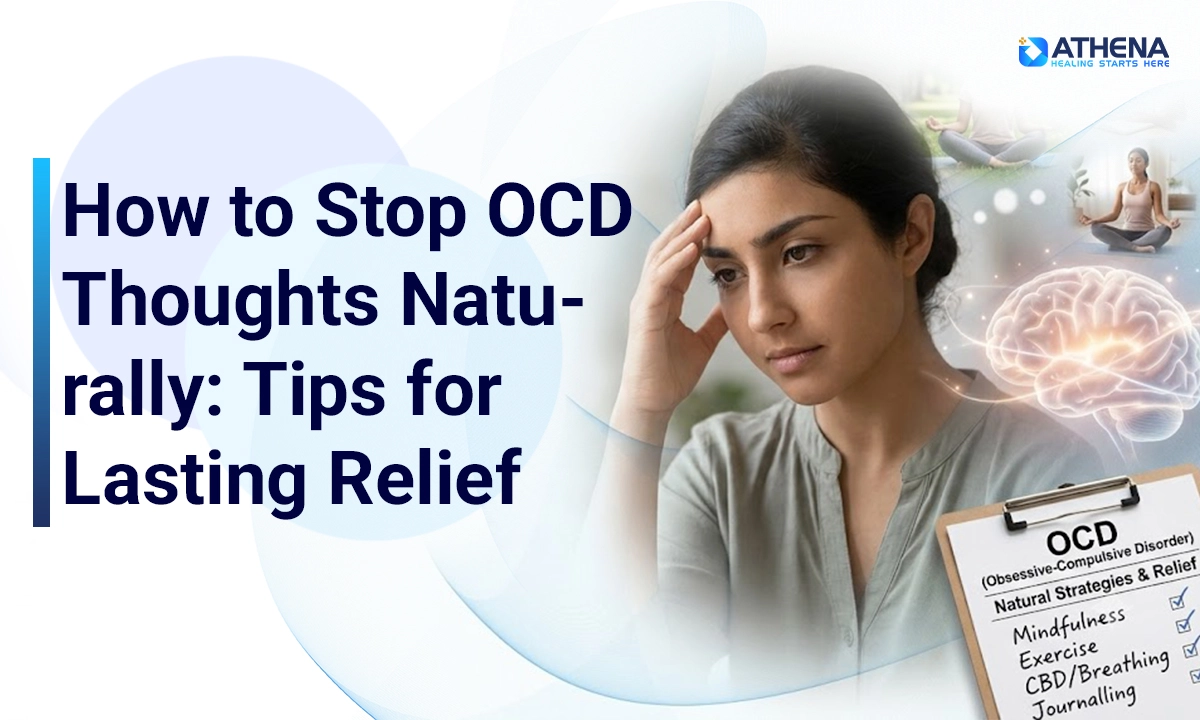
How to Stop OCD Thoughts Naturally: 8 Habits That Help
This list of actions will assist you in controlling the obsessive thoughts you experience since it takes away their source. For mild cases of OCD symptoms, the actions can be taken by themselves, but for severe cases, they supplement the treatment process. The following table outlines these actions.
# | Habits | What to do | What it changes |
1 | Name it | Say "this is an OCD thought" | Creates distance from the thought |
2 | Drop the debate | Notice it, then go back to your task | Stops you feeding it attention |
3 | Delay the ritual | Wait 10 minutes before acting | Shows anxiety fades by itself |
4 | Face triggers in steps | Use small, planned exposures | Retrains the alarm response |
5 | Practise mindfulness | 10 minutes of slow breathing daily | Builds the skill of watching without reacting |
6 | Cut reassurance | Ask family not to confirm or deny | Breaks the doubt and relief loop |
7 | Move and rest | 30 minutes of activity, 7-9 hours of sleep | Lowers baseline anxiety |
8 | Talk about it | Tell one trusted person | Reduces shame |
The most proven habit is Habit 4. This is known as exposure and response prevention (ERP), and about 50-60% of those using it experience a definite reduction in their symptoms. Begin by exposing yourself to minor triggers, like touching a doorknob without washing hands within five minutes. When dealing with major triggers, get guidance from a professional therapist. Other small daily habits also enable one to control OCD symptoms.
How to Stop OCD Thoughts Immediately
There is no technique that will make an obsession disappear instantly; however, one can make the anguish vanish quickly. The following techniques take less than a minute and should be practiced when easier days arrive to be ready for difficult days.
Inhale for 4 seconds and exhale for 6, repeat 5 times.
Remind yourself that it is an obsession and not a fact.
Postpone the ritual even for a few minutes.
Choose some task which requires the use of hands – cooking, tidying up a drawer, etc.
Talk to yourself as if you were talking to a friend.
Should one require the above routine to be carried out several times a day, then quick solutions will not do anymore and proper treatment will bring better results.
Can OCD Be Cured Completely?
Many people ask how to cure OCD thoughts for good. For most, OCD behaves like a long-term condition that can be controlled very well rather than one that vanishes forever. With the right care, symptoms often shrink until they stop deciding how your day goes.
A realistic way to overcome OCD thoughts is to expect odd thoughts to show up now and then while you stop acting on them. Over time they lose urgency, and many people describe them as background noise.
What Is the Best Treatment for OCD?
Guidelines recommend two main options, and many people end up using both. Therapy teaches the brain a new response, while medication lowers the intensity of anxiety so therapy is easier to practise. The table compares them.
Treatments | What it involves | Typical result |
CBT with ERP | Guided sessions where you face triggers without rituals | Steady gains over weeks to months |
SSRI medication | Daily tablets prescribed by a psychiatrist | Helps about 40-60% of patients, often within 8-12 weeks |
Combined care | Therapy and medication together | Often chosen for moderate to severe OCD |
The best treatment for OCD depends on how severe your symptoms are, how long you have had them and what has already been tried. Someone with mild checking habits may do well with ERP alone, while someone whose rituals fill half the day often needs both parts.
Timing also matters. Fewer than 20% of people worldwide receive any mental health treatment in a given year, and the figure drops to around 7% in low- and middle-income countries. Seeking help early puts you ahead of most.
Signs You Should See a Specialist
Self-help has limits, and knowing where they sit saves months of struggle. The signs below suggest it is time to talk to a professional.
Rituals or obsessing take more than an hour a day.
OCD affects your work, studies, sleep or relationships.
You avoid certain places, objects or people out of fear.
You feel low, hopeless or worn out by the cycle.
Habits that used to help have stopped working.
If you ever have thoughts of harming yourself, contact a mental health professional or emergency services straight away. The US-based National Institute of Mental Health also publishes a plain overview of obsessive-compulsive disorder that explains symptoms and treatment options.
How Is OCD Diagnosed?
OCD can look like anxiety, depression or even a personality trait, so the right label matters. A clinician asks about your thoughts, the rituals you use, how long this has gone on and how much of your day it takes. They also check for conditions that often overlap with OCD.
A psychiatric assessment brings all of this together in one sitting and gives you a clear starting point. With a confirmed diagnosis, psychiatric assessment and diagnosis turns treatment from guesswork into a plan.
Outpatient Treatment: Getting Better Without Pausing Your Life
Most people with OCD do not need to be admitted anywhere. Care happens through scheduled visits for therapy and medication review, so work, college and family life carry on.
This format suits anyone whose symptoms are disruptive but manageable with regular support, and families can stay involved. Many people recover through outpatient psychiatry, with sessions spaced weekly or fortnightly depending on progress.
OCD Treatment in India: Is Help Easier to Find Now?
In the past, getting an ERP specialist was difficult if one did not live in major cities, and being judged was another thing that prevented many families from opening up. Fortunately, this is no longer the case. Today, with online therapy and tele-mental-health services becoming more common, even patients living far away have access.
In case distance or judgmental attitudes had kept you away, this should no longer be the case.
OCD Care at Athena Behavioral Health
Athena Behavioral Health works with people dealing with obsessive thoughts, checking, contamination fears, mental rituals and the anxiety and low mood that often come with them. Care is planned around your triggers and daily routine, so you are never handed a generic programme.
A typical plan includes assessment, ERP-based therapy, medication review when needed and guidance for family members on how to respond without feeding rituals. Progress is reviewed regularly, and the plan changes as you improve. Athena's OCD treatment program is built on this step-by-step approach.