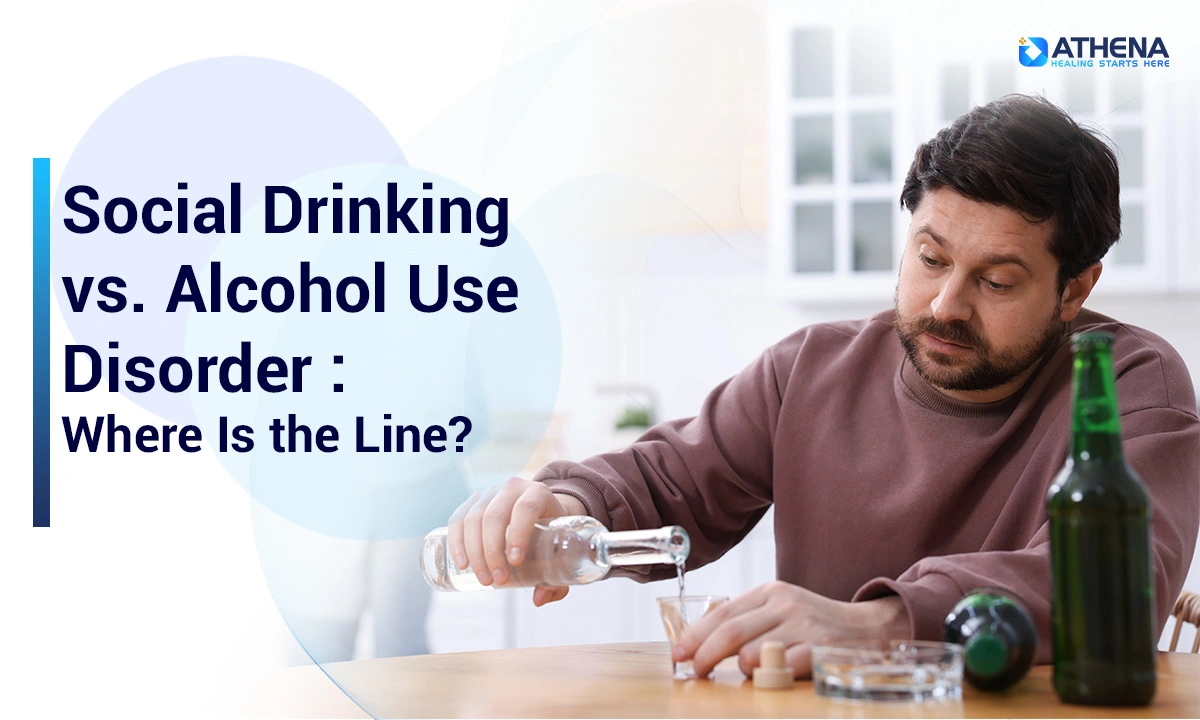

Social drinking vs alcoholism is mainly a question of control, consequences, and dependence, not simply how often someone drinks. Social drinking usually remains voluntary and manageable, while Alcohol Use Disorder (AUD) may involve cravings, unsuccessful attempts to cut down, tolerance, withdrawal, or continued drinking despite harm. A professional assessment is needed for diagnosis.
Social drinking vs alcoholism can be difficult to distinguish because problematic drinking often develops gradually. The key question is whether alcohol remains an occasional choice or begins affecting control, health, relationships, work, or emotional wellbeing. If you are concerned, Athena Behavioral Health can help you explore appropriate treatment and support.
What Is Social Drinking?
Understanding social drinking vs alcoholism starts with what social drinking generally means. Social drinking usually refers to consuming alcohol in settings such as dinners, celebrations, weddings, parties, or gatherings. A person may choose to drink occasionally without feeling compelled to do so.
Common characteristics include:
Drinking is usually connected to a particular occasion.
You can comfortably choose not to drink.
You do not regularly drink more or for longer than intended.
Alcohol does not interfere with important responsibilities.
You are not relying on alcohol to manage stress or difficult emotions.
You do not experience significant withdrawal when you do not drink.
However, “social” does not automatically mean harmless. The amount consumed, speed of drinking, individual health, medications, and circumstances can all affect alcohol-related risk.
Understanding
What Is Alcohol Use Disorder?
Alcohol Use Disorder (AUD) is the clinical term for a problematic pattern of alcohol use that causes significant distress or impairment. Healthcare professionals assess symptoms over 12 months and determine whether the disorder is mild, moderate, or severe. Symptoms can include drinking more or longer than intended, unsuccessful attempts to cut down, cravings, failure to meet responsibilities, and continued drinking despite problems.
This is why social drinking vs alcoholism cannot be determined by frequency alone. Someone can drink relatively infrequently and still have a serious problem if they repeatedly lose control or experience significant consequences.
The term “alcoholism” is commonly used in everyday conversation, but Alcohol Use Disorder is the more precise clinical terminology. Using both terms helps readers find relevant information while keeping the discussion medically appropriate.
Social Drinking vs Alcoholism: The Key Differences
The phrase social drinking vs alcoholism is commonly used online, but the most useful comparison focuses on a person’s relationship with alcohol rather than a simple number of drinks.
Social Drinking | Alcohol Use Disorder |
Usually voluntary | May feel difficult to control |
Often connected to social occasions | May occur outside social situations |
Drinking can generally be stopped | Cutting down may repeatedly prove difficult |
Cravings are not a dominant feature | Strong urges or cravings may occur |
Responsibilities remain manageable | Work, relationships, or responsibilities may be affected |
No significant withdrawal | Withdrawal can occur with physical dependence |
Alcohol remains one part of life | Alcohol may become increasingly central to daily life |
1. Control Over Drinking
With social drinking, a person can generally decide whether to drink, how much to drink, and when to stop. With AUD, there may be repeated attempts to cut down that do not succeed, or drinking may continue for longer than planned.
Review key
2. Cravings and Preoccupation
Enjoying a drink at dinner is different from experiencing a strong urge for alcohol that becomes difficult to ignore. Persistent cravings can be an important warning sign and are one of the symptoms clinicians consider when assessing AUD.
3. Consequences
A social drinker generally continues to manage work, family, studies, and relationships. AUD may contribute to conflict, missed responsibilities, poor decisions, financial difficulties, or reduced participation in activities that once mattered.
4. Tolerance
Tolerance means needing more alcohol to experience an effect that previously occurred with less. It can develop with repeated alcohol exposure and should be considered alongside other symptoms rather than used as a diagnosis by itself.
5. Withdrawal
Some people with alcohol dependence experience symptoms when alcohol use is reduced or stopped. These can include tremors, sweating, nausea, anxiety, rapid heartbeat, and sleep difficulties. Severe withdrawal can involve seizures or delirium tremens and may require urgent medical care.
6. Drinking to Cope With Stress
Occasionally having a drink after a difficult day is different from increasingly depending on alcohol to sleep, relax, manage stress, or escape difficult emotions. When alcohol becomes a primary coping mechanism, professional guidance can be valuable.
Read our guide on
7. Impact on Daily Life
One of the most important questions is: What is alcohol doing to your life?
Changes in health, relationships, work, safety, mood, or responsibilities deserve attention even if drinking still happens mostly in social settings.
Can Social Drinking Turn Into Alcohol Use Disorder?
The social drinking vs alcoholism boundary can shift gradually; problematic drinking does not always appear suddenly. A person may begin with occasional social drinking, move into a more regular pattern, and gradually notice that alcohol has become part of their routine or coping strategy.
However, there is no single fixed pathway. Not everyone who drinks regularly develops AUD, and the progression can look different from person to person.
Athena Behavioral Health describes a progression from experimental or social drinking through regular use, risky or problem drinking, dependence, and severe AUD as an educational framework. Its treatment information also emphasizes that early intervention can help people address problematic patterns before they become more disruptive.
Signs Your Drinking May Be Becoming a Problem
Consider speaking with a qualified professional if you notice several of these patterns:
You drink more or for longer than you planned.
You have tried to cut down but struggled.
You experience strong cravings.
You need more alcohol to experience the same effects.
Drinking interferes with work, family, or other responsibilities.
You continue drinking despite relationship, health, or emotional problems.
You spend substantial time obtaining alcohol, drinking, or recovering from its effects.
You experience withdrawal symptoms when you stop or reduce drinking.
These questions are useful for reflection, but they are not a diagnosis. NIAAA explains that healthcare professionals use DSM-5-TR criteria to assess AUD and determine its severity.
Does Drinking Every Weekend Mean You Have Alcohol Use Disorder?
No. Social drinking vs alcoholism cannot be decided by a weekend pattern alone; drinking every weekend does not automatically mean someone has AUD.
Clinicians consider a broader pattern involving control, cravings, consequences, tolerance, withdrawal, and other symptoms. Someone who drinks on weekends but has no significant symptoms may have a very different clinical picture from someone who drinks less frequently but repeatedly loses control or experiences serious consequences.
What Happens If You Stop Drinking Suddenly?
For someone with physical alcohol dependence, suddenly stopping can lead to withdrawal. Symptoms may range from anxiety, sweating, nausea, tremors, and sleep problems to seizures, hallucinations, and delirium tremens in severe cases.
Because withdrawal can become medically serious, anyone who drinks heavily or has previously experienced withdrawal should speak with a healthcare professional before attempting to stop. Athena provides medically supervised withdrawal management as part of its alcohol treatment approach, with clinical monitoring and ongoing assessment.
How Is Alcohol Use Disorder Diagnosed?
A qualified healthcare professional assesses drinking patterns, symptoms, medical history, mental health, and the effects alcohol has had on daily life. Under DSM-5-TR criteria, AUD is diagnosed when at least two of 11 symptoms occur within 12 months; the number of symptoms determines severity.
An assessment can also identify co-occurring conditions such as depression, anxiety, trauma-related concerns, or other substance use. NIAAA notes that several psychiatric conditions can co-occur with AUD, which is why a complete assessment is important.
Alcohol Addiction Treatment: What Help Can Look Like
Treatment depends on a person’s symptoms, physical health, level of dependence, mental health, and support system. There is no single approach that fits everyone.
Medical detoxification may be recommended when withdrawal requires clinical monitoring. Detox is only the beginning; ongoing treatment may include psychotherapy, medication when clinically appropriate, family counselling, relapse-prevention planning, and continuing care.
At Athena Behavioral Health, the current alcohol treatment approach includes medically supervised detoxification, psychiatric evaluation, Cognitive Behavioral Therapy (CBT), Motivational Interviewing, medication-assisted treatment where clinically indicated, and relapse prevention and aftercare. The organisation also describes personalised and confidential care across its treatment centres.
Medical Detoxification
Detox focuses on safely managing withdrawal when medical supervision is required. It should not be treated as the complete recovery process; continued therapeutic support is often needed after withdrawal is stabilised.
Therapy and Behavioural Support
Evidence-based therapies can help people identify triggers, understand drinking-related patterns, develop healthier coping strategies, and strengthen motivation for change. Family counselling may also help rebuild communication and support.
Learn practical approaches on
Relapse Prevention and Aftercare
Recovery continues beyond the initial treatment period. Follow-up therapy, family involvement, lifestyle changes, and relapse-prevention planning can help people maintain progress over time. Athena describes structured continuing care and aftercare as part of its treatment model.
Why Choose Athena Behavioral Health?
If drinking has become difficult to control, seeking an assessment does not mean you have failed or that you must immediately commit to residential treatment. It means getting clearer information about what is happening and what level of support may be appropriate.
Athena Behavioral Health provides psychiatry-led addiction care through a multidisciplinary team that includes psychiatrists, psychologists, and counsellors. Its approach also addresses co-occurring mental health concerns and incorporates structured recovery planning and aftercare. Athena describes its care as confidential, compassionate, and judgment-free.
Understanding social drinking vs alcoholism becomes much easier when you focus less on labels and more on control, consequences, and wellbeing. If alcohol is beginning to take more space in your life than you want it to, an early conversation with a qualified professional can be a practical first step.
Take the First Step With Athena Behavioral Health
If you or someone you love is struggling with alcohol, you do not have to navigate the situation alone. Athena Behavioral Health offers confidential, compassionate, judgment-free support and personalised alcohol addiction treatment, including medically supervised detox, therapy, psychiatric care, relapse prevention, and continuing recovery support.
Reach out to Athena Behavioral Health to discuss your concerns and understand what type of care may be appropriate. The first conversation can simply be about getting answers, understanding your options, and taking a safe, informed next step.