
The code is found on physicians' report, claims of insurance companies require it, and patients usually come across the code on their discharge papers – the schizophrenia ICD 10 code. In simple terms, the schizophrenia ICD 10 code without a subtype F20.9 is the general schizophrenia code, while paranoid schizophrenia is F20.0.
This article will go beyond just looking up the codes. There is more to it, such as why codes differ, where the discrepancy from one source to another arises, what takes place during the diagnosis, and the after-diagnosis support.
Schizophrenia ICD 10 Code in 30 Seconds
ICD-10 assigns every medical condition a short label so that clinics, hospitals and insurance companies all mean the same thing when they name it. Schizophrenia belongs to the F20 group. The code used most often is F20.9, which stands for "schizophrenia, unspecified."
A bare F20 is only a category title. Claims need the full code with its extra digits. Codes are also reviewed every October, so confirm the current list before you submit anything.
All ICD 10 Codes for Schizophrenia
Here is the ICD 10 classification of schizophrenia as it appears in the US edition, ICD-10-CM:
Codes | Names | What it points to |
F20.0 | Paranoid schizophrenia | Fear, suspicion, false beliefs and voices |
F20.1 | Disorganized schizophrenia | Confused speech, odd behavior, flat mood |
F20.2 | Catatonic schizophrenia | Rigid stillness or purposeless activity |
F20.3 | Undifferentiated schizophrenia | Criteria met, no single pattern stands out |
F20.5 | Residual schizophrenia | Lingering, milder symptoms after past episodes |
F20.81 | Schizophreniform disorder | Same symptoms, present under 6 months |
F20.89 | Other schizophrenia | Other named variations |
F20.9 | Schizophrenia, unspecified | Diagnosed, subtype not stated |
One number is missing on purpose. The WHO edition uses F20.4 for depression that follows schizophrenia, but the US list has no such code.
What Does the Paranoid Schizophrenia ICD 10 Code (F20.0) Mean?
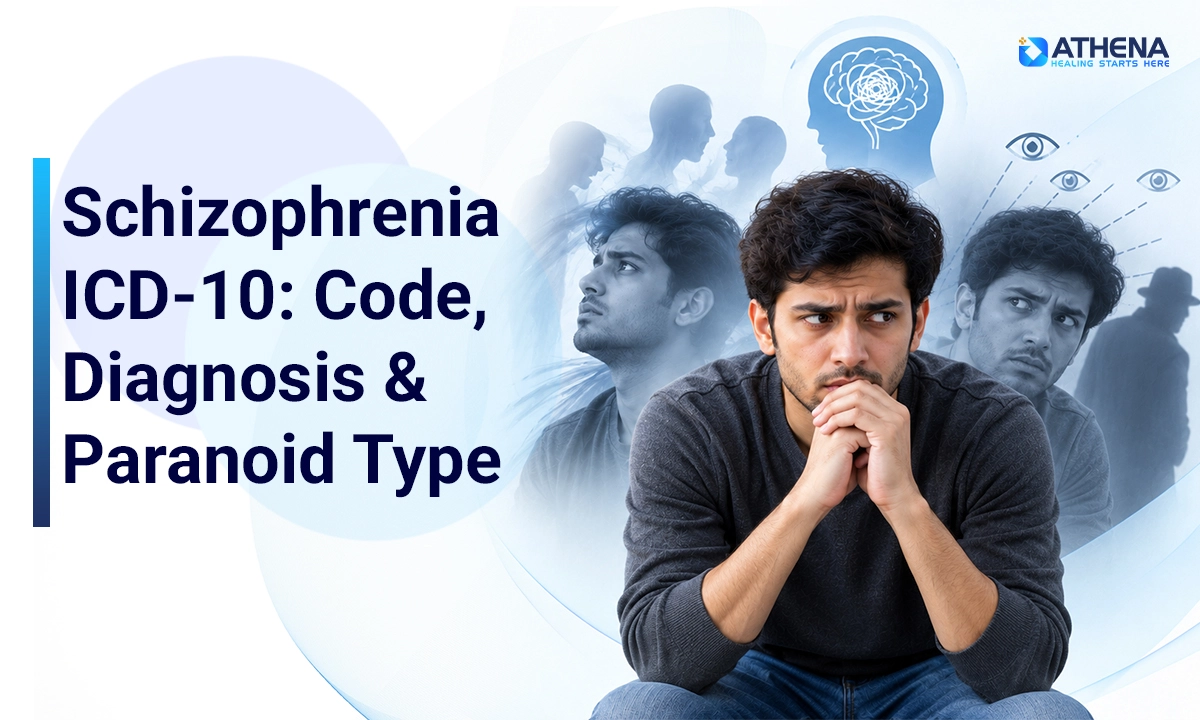
The paranoid schizophrenia code for ICD 10 is F20.0. It can also be referred to as the ICD 10 code for paranoid type schizophrenia.
Some of the symptoms associated with this subtype include:
Feeling that the neighbors, colleagues, or even relatives are conspiring against them.
Auditory hallucinations such as hearing voices making threats or giving orders.
Staying alert and declining to take any food, medications, and visiting from others due to fear.
Maintaining organization of speech and memory skills, which make it difficult to identify how sick the individual is.
Knowing about these symptoms may be frightening, but they are manageable and many patients show improvement after proper treatment.
Why Doctors Rarely Use the "Paranoid" Label Today
In 2013, the American DSM-5 manual removed every schizophrenia subtype. Research had shown that a person's symptom pattern often changes across years, so a label like "paranoid" could be wrong within a short time and gave little direction on treatment.
The code did not vanish, though. F20.0 is still valid in ICD-10-CM and in the WHO version, and some payers accept it. In most US clinics, the diagnosis is simply schizophrenia, recorded as F20.9, while the paranoid features are described in the notes.
Schizophrenia vs Schizoaffective Disorder: Code Comparison
The phrase schizoaffective schizophrenia ICD 10 shows up in many searches because the two illnesses overlap. They sit in different code families. Schizoaffective disorder is F25, and F20 specifically leaves it out.
Codes | Schizoaffective types |
F25.0 | Bipolar type, with manic episodes |
F25.1 | Depressive type |
F25.2 | Mixed type |
F25.8 | Other |
F25.9 | Unspecified |
Here, mood acts as the border between the two disorders. In schizoaffective disorder, there is an alternation of depression or mania with psychotic symptoms for a major portion of the disease. In schizophrenia, however, mood alterations may be brief or even minor.
ICD-10, ICD-11 or DSM-5: Which One Should You Follow?
Websites often disagree because they quote different manuals. The table below sorts them out:
Systems | Main purpose | Schizophrenia code | Subtypes? |
WHO ICD-10 | International health records | F20.0 to F20.9 | Yes |
ICD-10-CM | US billing and charts | F20.0 to F20.9 | Yes |
DSM-5 | US clinical diagnosis | Maps to F20.9 | No |
ICD-11 | WHO's newer edition | 6A20 | No |
If you work in a US clinic, use ICD-10-CM. If you are reading international research, check which edition the authors followed before comparing codes.
How a Schizophrenia Diagnosis Is Made
ICD code for schizophrenia forms the final stage. It is impossible to detect any biological marker in the body, therefore, the process involves detailed questioning and excluding all possible alternatives:
Detailed history: regarding signs, onset, family history, and functional impairments.
Physical and laboratory examination: excluding diseases of the thyroid gland, infection, epilepsy, or other neurological disorders.
Substance assessment: some medicines and alcohol intake can lead to a temporary psychotic state.
Criteria fulfillment: DSM-5 requires the presence of at least two key symptoms, one of which must be delusion, hallucinations, or disorganized speech over the period of 1 month in an overall disturbance that lasts for more than 6 months.
Coding: corresponding ICD-10 code is assigned.
This same process helps tell schizophrenia apart from bipolar disorder and from depression with psychotic features. If you are unsure what to expect, a psychiatric assessment and diagnosis walks through your symptoms and history in a structured way.
Early Warning Signs Families Often Notice First
The World Health Organization reports that roughly 1 in 300 people, or about 24 million, live with schizophrenia, based on its schizophrenia fact sheet. It tends to start between the late teens and mid-30s, and men are often affected earlier than women.
It seldom begins with a sudden break. Relatives frequently describe a slow slide:
Dropping hobbies and avoiding friends
Grades or work output falling for no clear reason
Sleeping badly and seeming constantly on edge
Speaking about strange ideas with total certainty
These early changes belong to the first of several phases of schizophrenia, and recognizing them gives families a head start on getting help.
What Does Schizophrenia Treatment Look Like?
Treatment can reduce symptoms and give a person more control over daily life. Most plans combine:
Antipsychotic medicine to calm hallucinations and false beliefs.
Talk therapy, including cognitive behavioral therapy.
Family teaching so relatives know how to respond in a crisis.
Practical skills work covering routines, school, jobs and independent living.
This is according to the WHO, which says that less than one in three individuals with psychotic disorder receives specialty services, and that patients with this disease die at twice or thrice the rate as the rest of the population, mostly due to preventable physical conditions.
Families commonly ask if the illness ever disappears for good. Most people manage it long term, and many enjoy extended remission, but the full answer on whether schizophrenia is curable is more nuanced than a simple yes or no. Healthy habits help too, and gentle routines such as mindfulness and yoga can ease stress alongside medical care.
Schizophrenia Care at Athena Behavioral Health
Athena Behavioral Health provides services for adult patients with schizophrenia and psychotic disorders.
Services provided by our mental health professionals and counselors:
A thorough assessment in order to verify the condition and exclude other possible reasons.
Medication management and evaluations of the treatment efficacy and possible adverse effects.
Individual therapy, targeting negative thoughts and voices and reducing daily stress.
Sessions for family members to show how to support their relatives at home.
Wellness services for better sleep, organization and functioning on daily basis.
Treatment plans may be altered based on the changing symptoms.