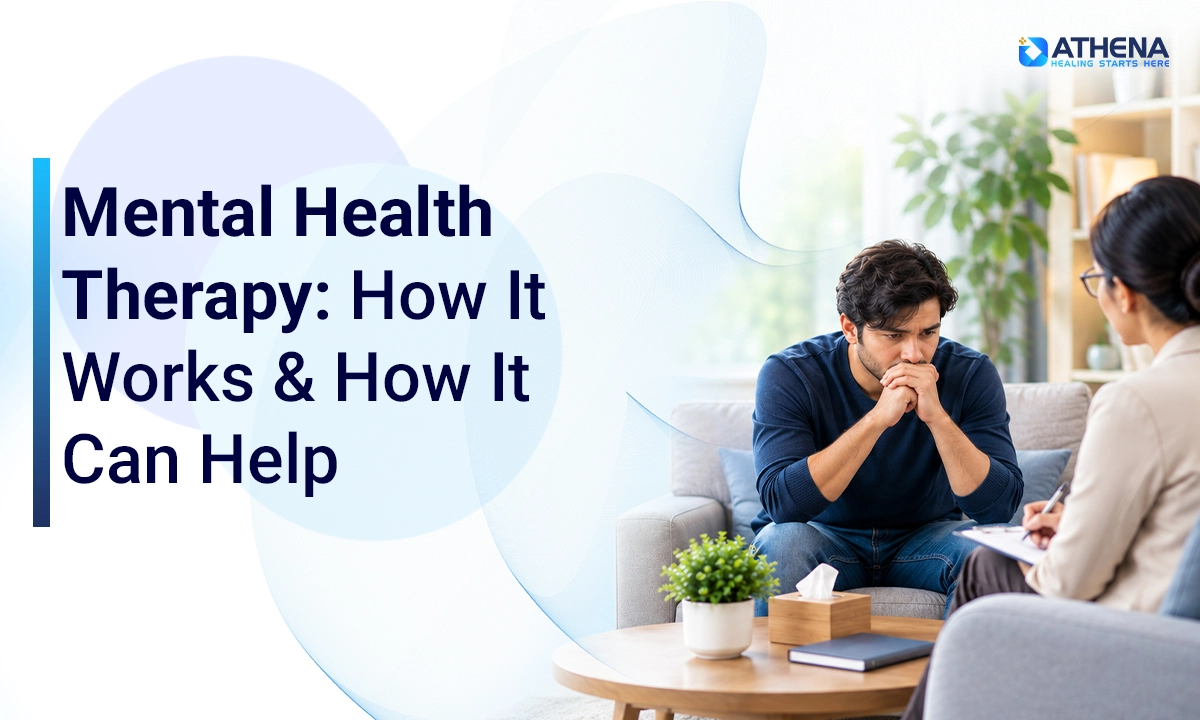

Some people struggle loudly. Many more struggle quietly. They still show up to work, still answer messages, and still smile in photos, while feeling drained, tense or flat on the inside. If that sounds like you, you are in very large company. Global health estimates suggest that around 970 million people, roughly 1 in 8, live with a mental health condition. Surveys in India put the figure at about 1 in 10 adults, and most of those people never receive any treatment, with the gap estimated at 70% to 92%.
Fortunately, there is good news: therapy has proven its effectiveness many times over. Research says that around 75 percent of patients receiving psychotherapy find it beneficial. This guide describes what mental health therapy is, what methods can be used for addressing different issues, and how one may start on the right foot.
What Is Mental Health Therapy?
Mental health therapy is a series of private, structured conversations with a trained professional. The aim is to help you make sense of difficult thoughts and feelings and to build practical ways of coping with them. You may hear it called talk therapy, psychotherapy, mental therapy or mind therapy. The label changes, but the idea does not: a confidential space, a proven method and someone qualified to guide you without judging you.
A typical session lasts between 45 minutes and an hour. You can receive therapy individually, in couples, in families, or in groups. Therapy isn’t about crises alone. Many people turn to therapy when dealing with burnout, bereavement, academic or professional stress, difficult relationships, poor self-worth, and even when things feel too heavy day-to-day.
How Does Mental Health Therapy Work?
Therapy can aid people because of the interconnectivity of thoughts, feelings, and behavior. Imagine yourself saying, "I am going to screw this presentation up". As a result, you become anxious, stop preparing and continue feeling anxious. Your therapist will identify the point of the vicious circle and how it can be broken. In general, any type of therapy involves four main stages:
- Evaluation: During the first two sessions, you and your therapist discuss your background, symptoms and functioning.
- Setting goals: Together you set specific goals for yourself which are to be considered an improvement (such as better sleep and attending events without fear).
- Skill training: During several weeks, you develop skills that will help you to overcome your problems (challenging your negative thoughts, relaxation techniques and exposure to feared situations).
- Maintenance: The last stage of the treatment involves learning signs of relapse.
Many evidence-based therapies show clear improvement within 8 to 20 sessions. The shift is not only emotional. Brain-imaging research shows that talking therapies can change activity in areas linked to fear and mood, which is why cognitive behavioral therapy can rewire your brain over time and make healthier reactions feel more natural.
What Happens in a First Therapy Session?
Because people do not know what to expect when going for their first counseling session, here is a description of what usually happens. The counselor is not expecting you to tell your entire life story in one sitting. The most part of it involves listening to you and asking you simple questions regarding why you came to them and how things are at work, school, and home.
In most first sessions you can expect:
- A plain explanation of confidentiality and where its limits lie
- Questions about your symptoms, stress levels and routine
- A conversation about what you hope will change
- A rough plan for how often you will meet and which approach might suit you
You always control the pace. If a topic feels too heavy, you can tell your therapist and come back to it later.
Types of Mental Health Therapy
There are dozens of therapy styles, and none is the right answer for everyone. This table compares the different types of mental health therapy you are most likely to come across, so you can match each one to a concern.
Types of Therapies | Works Best For | Usual Duration |
Cognitive Behavioral Therapy (CBT) | Depression, anxiety, panic, phobias | 12 to 20 sessions |
Dialectical Behavior Therapy (DBT) | Borderline personality disorder, intense emotions, self-harm urges | 6 to 12 months |
Interpersonal Therapy (IPT) | Depression tied to grief, conflict or loneliness | 12 to 16 sessions |
Exposure and Response Prevention (ERP) | OCD | 12 to 20 sessions |
Psychodynamic Therapy | Long-standing emotional patterns, low self-worth | Months to years |
Group Therapy | Shared experiences, social anxiety, isolation | Ongoing |
Family and Couples Therapy | Relationship conflict, supporting a loved one | 8 to 16 sessions |
Cognitive Behavioral Therapy (CBT)
CBT trains you to catch automatic thoughts such as "nobody really likes having me around" and check them against the evidence. It is among the most studied talk therapies anywhere and is used for a wide range of conditions.
Dialectical Behavior Therapy (DBT)
DBT balances accepting yourself as you are with learning skills to change. It covers mindfulness, handling distress, managing emotions and communicating clearly. It was created for people who feel emotions at very high intensity, and it is gaining ground across the country, as explained in this look at DBT therapy in India.
Psychodynamic and Interpersonal Therapy
These approaches explore how early experiences and close relationships shape your reactions today. They suit people who want to understand the "why" behind their patterns rather than only manage symptoms.
Group Therapy
Sitting in a room with people who truly understand what you are going through can lift shame faster than almost anything. Groups also give you a safe place to practise speaking up and listening. Many people find the shared understanding in group therapy is what finally helps them feel less alone.
Exposure-Based Therapy
If it’s a phobia, a panic disorder, or an OCD, therapists walk you through facing the situation in tiny bits. Eventually, your mind becomes aware that the terrible thing that may happen rarely happens.
Therapy for Depression: What Actually Helps?
Being depressed is more than feeling sad. Depression shows itself through fatigue, loss of interest in things once found pleasurable, inability to concentrate, disturbance of your eating and sleeping schedule, and an overall atmosphere of darkness. About 280 million individuals are affected by depression, yet it can be treated. Here are three best ways to treat your depression:
- CBT: fights the negativity and avoidance maintaining your low mood.
- Behavioral Activation: energizes you through organizing small meaningful actions regardless of lack of motivation.
- Interpersonal Therapy (IPT): helps you deal with the grief, transitions, and conflicts contributing to your depression.
For mild to moderate depression, therapy on its own can be as effective as medication. For more severe depression, combining the two usually works better. If you are unsure whether you need medicine, you can speak to a doctor from home through an online psychiatry consultation and get a clear answer without the travel.
Therapy for Anxiety: How to Calm an Overactive Mind
Anxiety goes beyond normal worry. It can bring a pounding heart, tight chest, restlessness, broken sleep and a mind that keeps rehearsing worst-case scenarios. About 301 million people worldwide have an anxiety disorder, making it the most common mental health condition. Effective therapy for anxiety usually combines:
- CBT to question catastrophic "what if" thinking.
- Exposure therapy to reduce avoidance step by step.
- Relaxation and mindfulness training to settle the body's stress response.
Many people feel a real difference within 6 to 12 weeks. When panic, social fear or constant worry starts running your days, structured anxiety disorder treatment can give you a clear path forward.
Therapy for Anxiety and Depression Together
Anxiety and depression often arrive as a pair. Nearly half of people with depression also have an anxiety disorder. You may feel hopeless and wound up at once, lie awake worrying, then feel too exhausted to do anything the next day.
The good news is that you rarely need two separate treatments. CBT and similar approaches work on what both conditions share: negative thinking, avoidance and unhelpful coping habits. A good therapist treats you as a whole person and adjusts the plan as your symptoms change. The cost of leaving these conditions untreated is huge, and the World Health Organization's mental health information notes that depression and anxiety alone drain roughly US$1 trillion from the global economy each year in lost productivity.
Borderline Personality Disorder Therapies
BPD occurs in 1.6% of all adults. People suffering from BPD are people that feel things very deeply, fear being abandoned and have their relationships swinging between intimacy and hostility. Although this can be tiring, there is a silver lining; studies done over extended periods of time have revealed that most of the people do not have BPD anymore after years of treatment. BPD treatments are:
- DBT: the first-choice treatment, designed specifically for BPD
- Mentalization-Based Therapy (MBT): strengthens your ability to understand your own and other people's thoughts and feelings
- Schema Therapy: works on deep-rooted patterns formed early in life
- Transference-Focused Psychotherapy: uses the relationship with your therapist to understand patterns in other relationships
Bipolar Disorder Therapies
Bipolar disorder involves swings between depressive lows and manic or hypomanic highs, and an estimated 40 million people live with it globally. Medication, usually a mood stabiliser, is the foundation of treatment. Therapy builds on top of it and lowers the chance of relapse. The most useful bipolar disorder therapies include:
- Psychoeducation: teaches you to recognise early warning signs of an episode.
- Interpersonal and Social Rhythm Therapy (IPSRT): steadies sleep and daily routines, which are common triggers.
- Family-Focused Therapy: helps loved ones support recovery and reduces tension at home.
- CBT: helps manage depressive phases and builds coping skills.
Because bipolar disorder calls for both medicine and talk therapy, having a psychiatrist and a therapist work together tends to give the best results.
Therapy for OCD
Obsessive-compulsive disorder is not about liking things tidy. It involves unwanted, distressing thoughts and repetitive actions performed to ease them, often eating up hours every day. Exposure and Response Prevention (ERP) is the leading therapy, and it helps roughly 60% to 80% of people cut their symptoms substantially. If intrusive thoughts and rituals are taking over your time, specialised OCD treatment can help you take that control back.
Mental Health Treatment: Therapy, Medication or Both?
The right route for mental health treatment depends on your condition and how severe it is. There is no single formula, but this table shows the usual pattern.
Approach | When It Is Usually Used |
Therapy only | Mild to moderate depression, anxiety and everyday stress |
Medication only | When therapy is not accessible, or as a short-term bridge |
Therapy plus medication | Moderate to severe depression, bipolar disorder, OCD and BPD |
Intensive programme | When weekly sessions are not enough but a hospital stay is not needed |
Therapy is one part of a larger picture, and it helps to understand the role of therapy in mental health treatment alongside medical care, lifestyle changes and family support. Combining these pieces is often what turns short-term relief into lasting recovery.
Therapist vs Counsellor vs Psychiatrist: What Is the Difference?
These titles are often used interchangeably, which makes it hard to know whom to approach first. In reality, each plays a different role:
- Counsellor: offers guidance and short-term support for stress, relationships and life changes.
- Therapist or clinical psychologist: provides in-depth, evidence-based treatment for diagnosed conditions.
- Psychiatrist: a medical doctor who diagnoses conditions and can prescribe medication.
Many people see a therapist and a psychiatrist together, and that teamwork often produces the strongest outcomes.
How to Choose the Right Mental Health Therapist
There continues to be evidence that the relationship between you and your mental health therapist remains one of the best indicators of success. Just some simple steps help make the decision easier:
- Qualification: look for an RCI-registered clinical psychologist, a psychiatrist or a licensed counsellor.
- Relevant experience: ask whether they have worked with your specific concern.
- Clear method: they should be able to explain their approach in plain words.
- Comfort level: you should feel heard, not judged. Trying two or three therapists is completely normal.
- Format and budget: choose in-person, online or hybrid, based on what you can realistically keep up.
Is Online Therapy as Effective as In-Person Therapy?
Yes, this is true for many. Depression and anxiety research has shown that virtual therapy can produce results that are as good as those achieved in person therapy sessions. This way of therapy excludes the need to travel; it offers a lot of confidentiality, making it more consistent, especially when you live in a busy city or small town, where few professionals are available. In person therapy would be better in case your condition is serious or you have reached the crisis stage.
Signs It May Be Time to Start Therapy
Waiting until things feel unbearable is a common mistake. It is worth speaking to a professional if you notice any of these:
- Sadness, worry or irritability lasting more than 2 weeks
- Big changes in sleep or appetite
- Pulling away from friends, family or work
- Panic attacks, constant overthinking or racing thoughts
- Feeling hopeless, numb or permanently exhausted
How to Improve Mental Health Without Therapy
Daily habits can support your mind whether you are handling everyday stress or are already in treatment. If you want to improve mental health without therapy, these small steps are a good place to begin:
- Move your body: even a 30-minute brisk walk can ease low mood.
- Protect your sleep: aim for 7 to 9 hours at consistent times.
- Practise mindfulness: 10 minutes of slow breathing can lower stress.
- Stay connected: talk to at least one trusted person every day.Limit late-night screens and cut back on constant news scrolling.
- Write it down: journaling helps you notice patterns in your mood.
These habits help, but they cannot replace professional care when symptoms persist or get worse.
Common Myths About Therapy
Wrong ideas about therapy stop many people from asking for help. Here is the truth behind the most common ones:
- Myth: "Therapy is only for serious illness." Fact: it also builds resilience, confidence and self-awareness.
- Myth: "Talking cannot change anything." Fact: outcome studies and brain-imaging research show real change.
- Myth: "It takes years." Fact: many people improve within 3 to 5 months.
- Myth: "I should manage this by myself." Fact: asking for help is a strength, not a weakness.
About Athena Behavioral Health
Athena Behavioral Health is an organization which provides mental health services under the assumption that getting professional assistance for issues such as depression and anxiety should be easy and free from any kind of stigma. The company does not offer only one program but, instead, assesses how much each client may need.
The following is how the support is usually provided:
- Online psychiatric consultations which would help you get your diagnosis and prescription without leaving your home.
- Therapy sessions based on approaches like CBT and DBT which are aimed at improving your mood and decreasing anxiety.
- Group therapy where patients with similar problems meet together to learn how to cope with them.
- A day care programme for those who need steady daily support but want to continue living at home.
The focus throughout is a personalised plan that fits around your work, family and routine instead of putting life on hold.